Wednesday, November 10, 2010
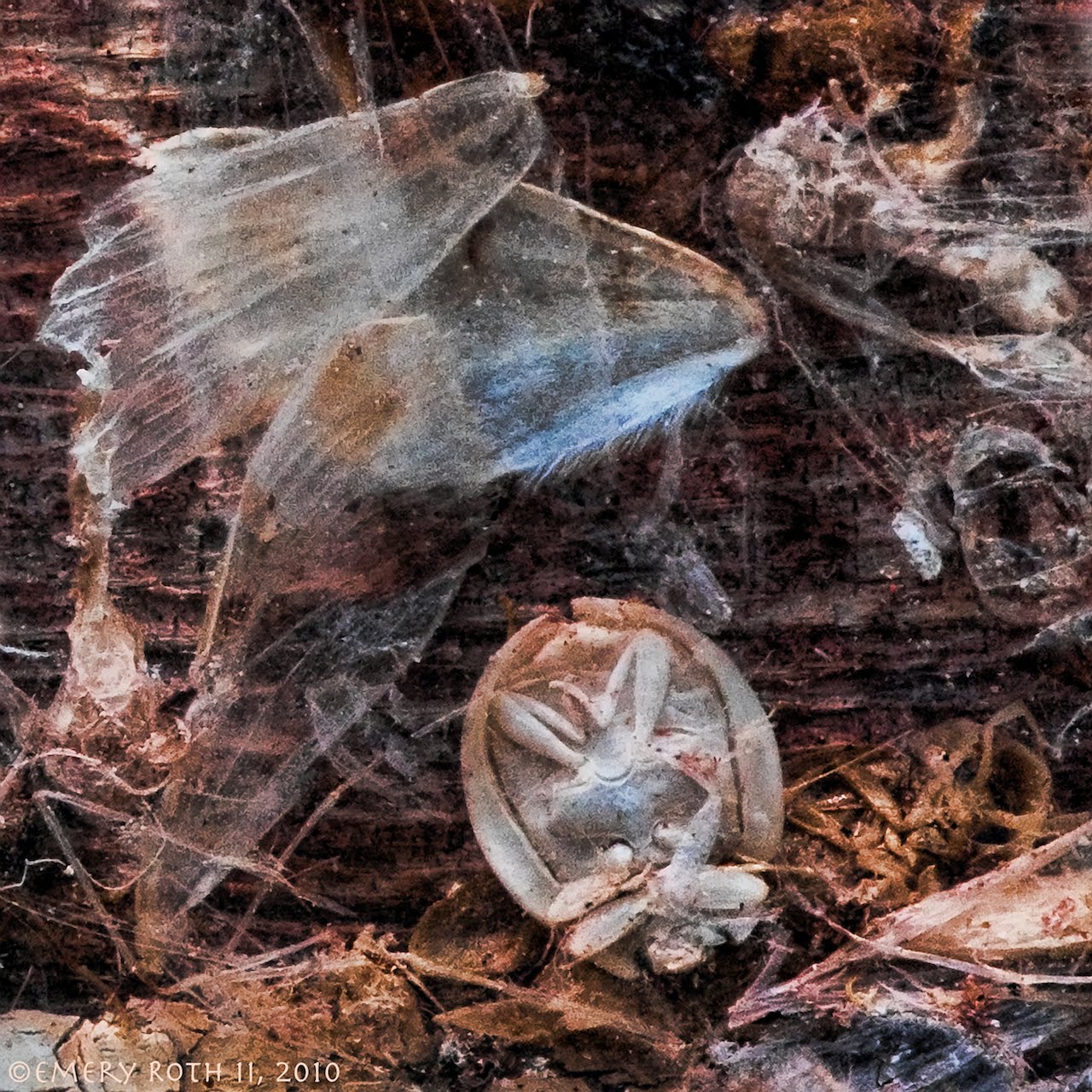
Bacchantes Liberati
PHOTOGRAPHER'S JOURNAL: While walking in a wooded valley in Sharon, Connecticut last week I met these bacchants - sylvan apparitions orbiting human imagination.
Tuesday, November 9, 2010
Beside the Housatonic River, Autumn, 2010, No. 2
PHOTOGRAPHER'S JOURNAL: As silos to dairy farms, so chimneys and towers to industrial mills. They make the horizontal world vertical; they offer the photographer opportunities and dilemmas. This tower, which is topped by a rusting tank, probably stored water pumped from the river for use in the mills.
Given certain conditions, it is clear that the inanimate, dead world strives with amazing determination and dexterity toward perception and differentiation. The most primitive cells say "I am," seek sentience to turn toward the light, and strive to distinguish between that which they can eat and that which will eat them. As hawks search for their prey, rivers seek the ocean, the sun holds the planets aloft, and yellowing vines cling to an ancient scaffold to reach the sun. Are they all animated by the same current? Where is its source, or is such a question paradoxical? Are the forms perceived its finite, corporeal shape, and are they intuited through sensing and perceiving organs that are also of its making? At least that's been my contemplation from here in the cave of my Cartesian heritage.
The old factory is quiet, the water tower above the river, empty. Here the leaves flare before the coming chill. This weekend the oaks, last holdouts, dropped their leaves, and now the chill is off the ocean blowing from the east and north, and on Monday everything was covered with ice.
Thursday, November 4, 2010
Reverie
PHOTOGRAPHER'S JOURNAL: Is the drowsy half sleep of becoming a premonition of the drowsy decay of going? Is that why these rising, spring lily pads look so like their decaying selves now settling back to pond bottom? On one side we celebrate the star-shaped, gleaming lily flowers and on the other, dread the star-like, mute infinitude.
Wednesday, November 3, 2010
Heat
PHOTOGRAPHER'S JOURNAL:
Transmogrification
Once they've felt the force,
the turning and grinding,
the hum
they say
stays in the castings,
reverberating through
shafts and pullies
down to the
last
punch.
Tuesday, November 2, 2010
Joker Ball
PHOTOGRAPHER'S JOURNAL, "Station Break": On Sunday I traveled with a friend to NYC where we met two other friends for the annual Greenwich Village, Halloween Parade, and so the processing of Halloween images must now compete with the processing of autumn images which has been competing for the past weeks with the taking of autumn images. As always, this means the images posted to TODAY'S are not the most current. I like to post in sets and try to place images in a somewhat ordered context, but the set of Maine images were interrupted when the factory images began, and the factory images soon became staggered as I inserted fall images which seemed to comment on them, and now all has halted as I try to make the most of autumn shooting.
In any case, this image was not taken at the celebrations in Greenwich Village but in the same antique store in Maine where I found the Sea Captain's Wife. The posting of Halloween parade images will most likely appear in the context of New Year's Eve or maybe May Day.
Images from the 2008 Halloween Parade can be found by scrolling back to November of 2008.
Tuesday, October 26, 2010
Roots
PHOTOGRAPHER'S JOURNAL:
The river still flows by,
though the concrete millrace is cracked and stagnant.
When is the first frost?
Sunday, October 24, 2010
Harlequin Autumn
PHOTOGRAPHER'S JOURNAL: The seasons wash away like garish laundry while we grow thin and sere waiting for rain.
Friday, October 22, 2010
Tiffany Mill Windows (fixed)
PHOTOGRAPHER'S JOURNAL: Why am I sending out the same image twice? I learned early on that for me routines are essential. I had parked along a ridge where the sun was going to set. It was spring and the trees were budding and blossoming. There were wonderful pictures to be had. Normally I hang by camera backpack on my tripod as I work. It serves as a convenient "desk" as well as a ballast. This time I wanted to move the tripod to lots of different locations quickly, and I set the bag against a tree. An hour or so later and several miles down the road I went to change lenses and realized that my bag with the lenses was... well, at the moment I wasn't sure. It was getting dark. I had driven between three locations.
Whether it is always putting a filled memory card or empty battery into my left pocket (empty cards and full batteries always go in the right), the particular steps I always take when exchanging lenses, or how I always hang my camera backpack on my tripod when I stop and shoot, violating those routines is a prescription for trouble. After ten minutes of heart-sinking panic I found my camera backpack propped against the tree when I rushed to take pictures at the first stop.
A note from a friend today praised yesterday's version of "Tiffany Mill Windows" but suggested that it appeared a bit dark. Again my heart sunk as I recalled that I had increased my monitor brightness some time ago and had for the past week or so been over-darkening images to compensate. I especially appreciate those who write to ask about a possible problem.
The over-darkening is most severe on images like this with important shadow areas. The effect is even more damaging on the previous TODAY'S image. I will slowly revise the recent images on this blog site. My apologies for violating my careful routines. Let this be a(nother) lesson to me.
Wednesday, October 20, 2010
Tiffany Mill Windows
PHOTOGRAPHER'S JOURNAL: The husk, the shell, the casing shucked at birth, or brittle, chalky bones? Sometimes it's hard to be sure, and the old walls are mute.
NOTE: All of these mill images look best when seen against a dark background. Here are a few earlier images inspired by the style of Louis Comfort Tiffany: Pond Tiffany, Tiffany Autumn. It seems autumn is Tiffany time.
Tuesday, October 19, 2010
Beside the Housatonic River, Autumn, 2010
PHOTOGRAPHER'S JOURNAL: They told me that time moves along a line, like a train on a railroad track vanishing into a dark, windy tunnel, but when I looked I saw it falling in layers, settling like old leaves and hickory nuts, the stones of Rome lying all about us.
Sunday, October 17, 2010
Unboarded
PHOTOGRAPHER'S JOURNAL: Leaves have turned earlier this year than I ever remember. Trees along the road were yellow well before October 5th, the marker I set on the year my daughter was born to measure future leaf change. There were few reds until a week ago, and color has survived the recent rains.
Autumn is a fit backdrop for this forgotten mill town where few trains pass, and it feels right that on several shoots here I have had to keep my camera sheltered under my "Rothcloth," (a photographic invention of mine that has been "manufactured" by Jane) while frequently wiping raindrops from the lens.
Many of the old mill buildings here are colossal ruins. A few still rent office space to small businesses. Some storefronts in town are for rent, others suggest another age. Friends tell me it's all a symptom of post-industrial society, and I wonder what "post-industrial society," might be. Is there such a thing?
I've been shooting here while processing photos of Maine fishing harbors, both remnants, some would say relics, of industrial America?
Thursday, October 14, 2010
The Sea-Captain's Wife
PHOTOGRAPHER'S JOURNAL: What can we know of the sea captain's wife who I met in one of those uniquely Maine, second-hand outposts of homeless stuff? She could have lived looking out to sea in a captain's house like the ones I pass in Belfast and Camden, and Searsport with their ship-shape carpentry and their widow's walks, all B&Bs today.
Tuesday, October 12, 2010
Web Catch
PHOTOGRAPHER'S JOURNAL: Thurston's lobster pound in Bernard is a great place to eat the freshest lobster available, and the wharves at Thurston's are one of my favorite spots to catch photos of the lobster industry. When we were there just after Labor Day the wharves were beginning to fill with traps. I've been there in early spring, at the beginning of the season when only a labyrinth of narrow passages, littered with buoys and gear winds mysteriously around each wharf between walls of piled up traps.
On the second day of our trip we caught our first sunrise in Southwest Harbor, then picked up coffee and were on Thurston's wharves in Bernard just after the sun topped the hills across Bass Harbor. I didn't know what I wanted to shoot when the low sun beamed down a row of traps. It caught the webbing of these three that stood out of alignment.
Around the corner I found another web that I thought worth photographing. A spider the size of a half dollar had built an enormous web in the sun among the traps. Photographer's are mostly scavengers, ragpickers. We wander and observe and find our prey where we can, not at all like lobstermen or spiders.
Monday, October 11, 2010
Dirty Jobs
PHOTOGRAPHER'S JOURNAL: Lobsterman can use up two of these tubs in a day. The herring are heavily salted and stored in warehouses by the shore. Aboard the boat they will be stuffed into fist-sized, mesh, bait "pockets" to refresh the traps as they are pulled. The old bait pocket must be retrieved, emptied, reused. Definitely a dirty job.
Thursday, October 7, 2010
Lobsterman's Commute
PHOTOGRAPHER'S JOURNAL: Every job has its rhythm. For the lobsterman day begins paddling or motoring to his lobster boat which he has moored in the center of the harbor. Watch them any morning at the loading docks around Bass Harbor, taking turns to pull alongside one of the wharves by a winch. They stop on the dock and chat and drink coffee. While the captain gets the boat, the mate may get the bait and get it ready to be lowered to the deck. Perhaps new traps are to be set that day. They must be loaded too, or pulled traps from the day before may have to be unloaded. Well before most people are having their first coffee, pickups have formed a quiet row, red, blue and silver beside the common wharf in Bernard. The lobstermen are at sea.
Last year I photographed a day aboard The Dillon Chris and Linda with Captain Howard and Mate Roger, and I made a slide show of the photos. To view the slide show click: SLIDE SHOW.
Wednesday, October 6, 2010
Composition with Herring
GUEST JOURNAL by JANE ROTH:
Sardine Dilemmas
Skinless, boneless, packed in oil?
A key?
Twist or pry?
Who invented this?
Ribbon of metal?
A cut?
bleed or starve?
What kind of cracker?
Tuesday, October 5, 2010
Gulled
PHOTOGRAPHER'S JOURNAL - Herring is the preferred bait of the lobstermen. Warehouses and sheds packed with salted herring make the gull's contest for pecking order especially aggressive here. Watch them for awhile and see if you can spot top bird. These are not the obsequious gulls who beg at the pull-offs on the road to the top of Cadillac Mountain, hoping with their doorman-like deference to claim a bit of your lunch. Around the harbor, we're in the big league.
Monday, October 4, 2010
Graduation
PHOTOGRAPHER'S JOURNAL:
Lobster Bait
We are well-schooled.
We stay close,
move with our neighbors,
keep our distance,
align polarity,
swim only with those of our color and size,
diving - a flash.
Slipstreaming in a hydro peloton,
we hardly know who leads,
sifting krill,
upwelling with a plankton coriolis,
quivering with wild energy.
a whirling galaxy,
devouring mind incarnate.
Saturday, October 2, 2010
Lobsterman's Shack
PHOTOGRAPHER'S JOURNAL:
Salt Cod Soul
How old is that fish smell that stains the boards of your old shack,
that salts itself on your forehead, stings your eyes
and swims in your blood? Was it pickled in wood traps
drying in the sun with their sea urchin freight
and their rotting crabs? They were always breaking, and you
were never without spare lath and a hammer and nail.
Was it there before haulers drew the warp
swiftly through your glove, back when you
hauled by hand from a dory at the harbor's edge
and sold three pound lobsters to the canneries - and later
when they filled three pound cans with half-pound bugs?
And was it the same when all the canneries closed?
Is the taste the same as sailing with seiners
on silken schooners beside the mackerel shoal,
till you spring at once to the seine boat, stealthily
circle the shoal, then draw the purse string shut -
fifty barrels of mackerel at a time,
though you ate dried cod and pickles for a month?
And on your way home with a bushel of salted herring
bungied in the back of your black, Dodge Ram
for another day at sea... what sweet smell
mingles with your wake and fills forgotten dreams.
settles like the smoke from your old wood stove
and rings in your ear like the call of the running tide?
Thursday, September 30, 2010
Low Tide
DAVID L. LUNT (from Hauling by Hand, by Dean Lawrence Lunt): "I started when I was 10 (1948) with just a few traps around the harbor. The first year I had a rowboat and the next year I had a little, aircooled Lawson outboard that I put on it. I started out with maybe 25 traps right around the harbor. We used to go around the shore and pick up traps that people didn't want to bother with and patch those up. We also had some traps that the bigger fishermen didn't want and had discarded. We would patch those up too. The traps were good enough to fish inside and for us to haul by hand, but they weren't good enough to haul in boats. They wouldn't hold up. We also picked up old buoys and stuff around the shore. We used rope people had discarded and couldn't haul with the winch heads anymore. That is just about what everyone started out with - everyone my age."
PHOTOGRAPHER'S JOURNAL: Corea with its shoreline of docks may be the most traditional looking of New England fishing towns, but few lobstermen care much about making it look authentic. It just is.
Low tide, a time one doesn't want to arrive at the dock with a truckload of fresh bait. Tides were most extreme when we were in Corea, high highs and low lows, and seeing the docks stranded like this makes clear how much lobstermen move by the tides. I had high rubber boots with me which I carry for wading into the mud, but I forgot to use them here. There are pictures to be made from under these docks.
Many of the docks have classic fishing shacks whose use, nature and contents, until this trip, have remained a mystery to me.
Wednesday, September 29, 2010
September Song
DEAN LAWRENCE LUNT (from Hauling by Hand): "Yet another chore was making and mending trap 'heads' and bait pockets. Heads are the mesh netting made of twine that are stretched across the ends of traps and form the entrance to a trap on the side. Inside each trap, a mesh, funnel-shaped netting allows the lobster to move from the compartment with the bait to a second compartment called a "parlor." It is in the parlor that the lobster is trapped.... A common sight in island homes during the first 75 years of the 20th century was a man or woman sitting in the kitchen with a string attached to the kitchen doorknob, pulling wooden needles and cotton twine around a 'mesh board' --- a wooden block similar in shape to a harmonica --- to makes heads or pockets. Islanders sometimes held knitting bees at which eight or 10 people might gather at a house for ice cream and cake and to knit heads."
PHOTOGRAPHER'S JOURNAL: This image is from mid-September. The lobsters are in retreat to deeper, warmer waters, and lobstermen are pulling back their traps; nearest to shore come in first. Each wharf is filling with them and buoys, toggles and ropes. The lobstermen have spent their summer as I've heard them say, "Trying to outthink the lobsters." The hunt is learned from early childhood, passed from father to son and now sometimes to daughters too. I see stove pipes on many of the lobster shacks, so there is a winter routine as well. If I return in the spring I know I will see rows of scrubbed traps with ropes, buoys, and toggles neatly packaged inside in readiness for the lobsters' return.
Monday, September 27, 2010
A Splash of Gulls
NOTE: On September 30, Blurb is raising prices.
BOOKLINKS
"Best of Today's," regular format: http://www.blurb.com/my/book/detail/1169668
"Best of Today's," deluxe format: http://www.blurb.com/my/book/detail/1169042
"Farm," regular format: http://www.blurb.com/my/book/detail/1524641
"Farm," deluxe format: http://www.blurb.com/my/book/detail/1524592
Sunday, September 26, 2010
Exeunt Geese
PHOTOGRAPHER'S JOURNAL: Just before shooting this series of photos we chatted with a lobsterman moving traps nearby. He spoke with a gingered, Maine twang, and he let us photograph from his wharf. When asked about the wrecked shack that had come through Hanna unmarked, he said, "That old thing? It's been like that fa fahty yeahs."
I wondered what it might look like inside. His own wharf had clean, new deck, and he talked about working on it. The nine crusty traps he had just set on it might leave the first stains. He explained that decks wear out, but the salt preserves the pilings which go deep and can last hundreds of years.
Friday, September 24, 2010
Docking Rights
PHOTOGRAPHER'S JOURNAL:
Docking Rights
Just as the right to fish in a given "precinct" is passed from parent to child,
the use of a family dock seems to be be a family inheritance,
a place to launch traps from in spring
and to set them in fall,
a place of daily common purpose,
a place that ebbs and flows with the tide.
Thursday, September 23, 2010
Brinks
PHOTOGRAPHER'S JOURNAL: And so, this September 11th, after trying to catch sunrise on Cadillac Mountain, Lazlo and I drove around to the Schoodic Peninsula and to Corea. Not only had Hanna spared the shack, but the gull was still on the rock. We arrived in time to watch a gaggle of geese test his claim to back-of-the-bay turf. The geese halted just off shore. Had they come also to check us out, or was this a daily strut to put the gulls on notice as to just whose bay this was? Two winters and two summers had hardly aged the shack. The box of rock that looked ready to fall into the sea in 2008 seemed no more nor less improbable in 2010.
Be sure to click on the photo to see it large.
Tuesday, September 21, 2010
Corea in Fog, September, 2008
PHOTOGRAPHER'S JOURNAL: In September of 2008 in Corea, Maine, I first noticed lobster shacks as a species of subject matter. I photographed this one for over an hour as fog drifted in and out with the cackle of seagulls. My gull models barely moved. It occurred to me the shack might not be here after Hanna blew through.
I processed and posted two shots to TODAY'S shortly after returning home. This is another from that series. How differently I choose to process it now, two years later! The two images processed in 2008 can be viewed here: Corea Harbor Gull Watch; Lobster Shack, Corea.
After Hanna I couldn't return to Corea and haven't been back since. As Lazlo and I headed toward Corea this fall, I wondered if there'd be anything left of the shack.
Monday, September 20, 2010
Back of the Harbor, Corea, Maine
PHOTOGRAPHER'S JOURNAL: The Schoodic Peninsula is the next peninsula north of Mount Dessert Island. My annual trips didn't get this far Down East until September of 2008. I drove into the tiny harbor of Corea as the weather bureau was tracking Hurricane Hanna. I arrived in the early afternoon and spent most of my time on the western side of the harbor which seemed more interesting.
This image was taken at the very back of the harbor where a freshwater stream has cut a tiny inlet for the salt water to fill. I failed to process the image initially because I was busy with images from the, just completed, Olsen House workshop, and I didn't realize that the two shots that make the image could be stitched into a satisfying panorama. I spent the evening at Schoodic Point and turned toward my B&B just before sunset as the winds were building, and the surf was raging. I thought Schoodic Point would be a good place to shoot from the next morning with Hanna in retreat.
The tiny harbor of Corea probably looks much as it did a century ago, though I suspect more open then; less wooded. Originally called Indian Harbor, the first settlers didn't arrive in Corea until 1812, and they have been supporting themselves on fishing ever since. There are two lobster pounds, but what's most evident are the dozens of private docks, many with shaky fishing shacks, that circle the harbor. Even today Corea lies just beyond the range of most tourists. Those who make it this far are more likely to spend their time at Schoodic Point.
The next morning the road to my B&B was under water. I packed, paced, lingered over breakfast and imagined Schoodic Point. Then all at once the new lake in front of the B&B emptied as if a drain had been unplugged somewhere. I was on my way, but the road to the Point was also washed out. In fact the end of the peninsula was split in half by a gully where the main road should have passed. I wasn't even sure I could get back to Corea. I decided the best plan was to find my way off the peninsula, as it turned out, through a labyrinth of still passable roads; it was a strategic retreat, and I wasn't really sure I had made it until I reached Route 1. This trip with Lazlo was the first time I've been back.
NOTE: Once again I hope to be shooting at New York's Halloween Parade with friends. It is arguably the best parade outside New Orleans. It only costs a moment of time to support the parade with your vote. For info: http://www.halloween-nyc.com/VOTE.html
Friday, September 17, 2010
Morris Yachts
PHOTOGRAPHER'S JOURNAL: There's been a lighthouse at Bass Harbor head since September of 1858 when John Thurston and his family took up residence there. The lens installed in the lighthouse in 1902 is still in use today. The bay outside Bass Harbor is sheltered by five small islands: Great Gott Island, Little Gott Island, Black Island, Placentia Island and Swanns Island. It has long been known among sailors and captains as a safe refuge from the ravages of winter weather and from foul winds whenever they blow. Since the 18th century large, transatlantic, sailing vessels often made use of its shelter on their way into and out of ports farther west, Portland; Portsmouth, Boston, Providence, New Haven, New York, and Philadelphia. In the shelter of these island, Bass Harbor thrived as a nearly mainland outpost of Maine fishing.
Most of the boats that sail out of Bass Harbor today are lobster boats. There are two active lobster pounds there which buy the daily catch, but some lobsterman prefer the town dock on the Bernard side. These independent lobstermen sell to middlemen who drive there trucks out on the dock and weigh and buy from the incoming boats. Fishermen always preferred good harbors on the outer reaches of Maine's peninsulas and on its islands. Being that far out gave them a head-start on getting to the catch. Lack of modern conveniences and the advantages of motorized fishing boats mean fewer commercial fishermen fish from the islands these days, but Bass harbor offers all the advantages of being near the outer edge and none of the inconveniences of island life, and it remains a center of lobstering.
The old Underwood Sardine Factory in Bass Harbor has been closed as long as I remember, and the only catch now is lobster. Continue past the brick Underwood Building and the ferry terminal and you'll reach Morris Yachts. They continue New England's traditions of fine, custom, boat building and design. I'm told they recently completed a yacht for Martha Stewart painted in a color they promise will remain unique. Bass Harbor is a commercial harbor. They build the yachts here, but the yachts find home port elsewhere.
I took this picture on my trip with Jane in early spring.
Wednesday, September 15, 2010
The Young Lobsterman
PHOTOGRAPHER'S JOURNAL: Is coastal fishing the last great industry serving an extended market that is owned and run by local small businessmen? I usually don't post a picture to illustrate a story, but on my visit to Maine last June I spotted a young lobsterman loading traps onto the smallest lobster boat I had ever seen. It was then I realized how special the lobster industry in Maine really is.
The boats in this harbor are all lobster boats. As the picture shows, some are three, some are four windows wide. The boat in the foreground is wide enough for just a single person. I've watched lobstermen at work. Captain and mate are a coordinated team. When they fail boats wind up on the rocks, and lines get hopelessly tangled. Finding, hauling, emptying, baiting, and dropping 250 traps is an exhausting day's labor for two men. I wanted to know what the young lobsterman loading the boat alone was up to.
I quickly learned how serious he was. Lobster permits and territory are managed by the lobstermen themselves. Each harbor has its lobstering territory and the right to set traps there is granted by the lobstermen of that harbor. Lobstermen from Bass Harbor don't set traps in the waters that belong to the lobstermen of nearby Swann's Island on one side or the lobstermen of Frenchman's Cove on the other. Only the lobstermen know the arcane rules governing the extents of each territory, the information passed down from generation to generation, honored and respected. In this way the entire coast of Maine is divided into lobstering precincts, and those who drop traps in waters where they are not licensed will quickly find their lines cut and their traps lost. The number of lobstermen fishing any precinct is strictly limited by the lobstermen as is the number of traps each may drop. A master lobsterman might be permitted as many as 800 traps in the precinct. The only way to gain a permit to set traps in a given precinct is to be a resident of that precinct and the child of a lobsterman. Thus lobstering has been passed from father to son for generations.
The young lobsterman told me he had just gotten a permit increasing the number of traps he could set to 500. The boat was his and the income was helping him put himself through college. Since meeting him I've noted more than one tiny lobster boat dropping traps, and I'm feeling optimistic about lobstering in Maine.
Once fish were so plentiful along the coast of New England that they were used as fertilizer. Lobsters could be pulled by hand along the shore without use of a trap. One by one Maine fishermen fished out all of the other catches of the area. When lobster was the only thing left, it was the fishermen who organized to create rules to prevent depletion of their last refuge. If the lobsters were fished out, there would be no more fishing industry in Maine, no work for their children. Although federal regulations cover broad issues of lobstering, it is the fishermen themselves who have implemented the most important conservation measures. The story of Maine lobstering is a model and an example.
Tuesday, September 14, 2010
Tranquil Sea
As I review the photos from my most recent trip I will try to post a few photos from previous trips. This will give me time to prepare new ones to follow these. Meanwhile, other photos from this summer in Connecticut are ready to appear, but they must wait. How do I keep a balance between photographing, processing and posting so that I'm not constantly behind in all three? When will TODAY'S really be TODAY'S? How do I find time amid these tasks to reach for words that go beyond my daily photo processes?
These are questions best not answered. I must take things patiently, follow inner cues. In any case, with my camera out for repair, I will not be creating new exposures this week.
Friday, September 3, 2010
Bounty No. 2
PHOTOGRAPHER'S JOURNAL: It is often my goal to try to catch the roll of the New England hills. Out West the landscape itself provides numerous features, but in New England I usually must rely on man-made objects to help organize and provide focus to a composition.
The fields behind Smithfield Guernsey Farm offer one of the best spots from which to appreciate these hills and the labyrinth of creases that divide them and through which many of the roads are threaded. The old farm road reaches an elevation of almost 1100 feet, but the slope is gentle in every direction and once at the top I'm always surprised at how far I can see. Connecticut's hills are no higher but more tightly packed.
Smithfield Guernsey is one of the few, large dairy farms remaining in the area, and as their web site points out, they thrive by innovating. No other farm in the area has such a castle of aluminum bins, hoppers, and sheds for equipment and feed. In addition to grazing land, they have over 2000 acres under cultivation. Once one is up top behind Smithfield Guernsey the view is cropland in every direction.
Special thanks to Arlene Petterson for introducing me to this place.
Monday, August 30, 2010
Aubade
PHOTOGRAPHER'S JOURNAL: Once again I can feel the season turning. We have passed the cusp of summer when it felt as if a sunset shoot must always keep me shooting past 9 PM and a sunrise shoot meant living with 4 or 5 hours of sleep. Already it's getting easier to shoot at sunrise.
Today I saw a pond filled with Canada Geese all as still as stones and facing the sun at midday, but even they must be getting anxious and having martial thoughts; soon it will be time to begin autumn maneuvers, staggered squadrons launched at intervals, barking from pond to pond the goose nation's sky command.
Looking back over where I've been it's clear much of the summer I spent threading the labyrinth of Hudson Hills discovering new territory among disorganized valleys. Too often my wanderings led through abandoned barns and barns whose owners couldn't afford to fix the rotting roof. Empty dairy barns sit beside un-grazed pastures that may one day sprout rows of boxy homes or giant hanger-like barns for colossal horse farms or farms of prize cattle. Tomorrow I'll wake early and hope for morning fog.
Saturday, August 28, 2010
Lethe Waters No. 2
JILL ENFIELD: "Every setting conveys a thousand realities and the joy of photography comes with emphasizing the dimensions that bring personal choice to bear. A still scene w/o apparent action can reflect anything between tranquility and horror. Leaving it's capturer the choice."
PHOTOGRAPHER'S JOURNAL: Several friends wrote in to say the previous image was one of their favorites. Several others wrote to say they would have liked it better if, "the processing had been more conventional." or as another put it, "more photographic." In fact, the image above and the previous image were rendered simultaneously. Each time I adjusted one so it became my preferred version, I'd work on the other until I liked it better. Working on this version I always tried to maintain the look of photographic reality. Within that world alone there are an infinite number of choices. In the other version I gave free play to possibilities outside that expected photo reality though without changing the forms of the image.
In the end I wonder if the two images may not show the same place viewed from opposite shores. In any case, I'm interested in knowing if viewers have clear preferences for one or the other. Or better yet, I'd love to know how the two images feel different, suggest different kinds of reality, perhaps.
Be sure to click on both images to view them large.
I should add that there are a few elements in the images that were not treated the same. Most noticeably, in the previous image I took a tiny delight, perhaps perverse, in leaving the power lines that tell of a road just behind the cemetery. Of course, there was no question that they had to be removed from this, photo-realistic version.
REMINDERS:
Farm: Personal Wanderings through the Berkshire, Hudson, and Taconic Hills remains on view at the exhibit and online at my blog site and at these links: LARGE VERSION, REGULAR VERSION
Wednesday, August 25, 2010
Lethe Waters
PHOTOGRAPHER'S JOURNAL: Sometimes they are cared for, nestled beside a church or on a hillside on the edge of town or even when they appear unexpectedly along a wooded stretch of dirt road or in the middle of a farmer's field. I also find them abandoned, overgrown in the middle of the woods or beside an auto dealership or next to a strip mall. Outposts of time where even the blank stones whisper - stand there like the men and women and children too who once they were when they animated this place, and I marvel at Earth's relentless spin.
Sunday, August 22, 2010
Garden of Earthly Delights No. 5
PHOTOGRAPHER'S JOURNAL: My father always had a garden. He loved making things grow, and even when we were living in New York City, he had an area of the dining room crowded with potted plants, and a bit of the window sill beside the fish tanks lined with stem-filled bottles of rank water and roots, and glasses where old pits sat unmoving, suspended by tooth picks. Each summer we rented a house with a garden where I quickly learned to walk carefully to avoid stepping on tiny things I couldn't see. I can still remember watching him in awe and terror, in that garden where the tomatoes were a jungle canopy high over my head, petting a bumble bee for me on his finger.
It was a trick, of course, and I'm not sure where he learned it. I don't think he thought it was something the bee enjoyed, just something it permitted. That's what it was to me, anyhow, a scary trick, and I never had the courage to learn it.
Many years later, when my parents were no longer renters but owned their own garden, my father had plants wherever he could. They were in the living room and on the porch. A small greenhouse was tucked against an outside wall where living room windows looked into it, and the work room we called, "the tool house," was so filled with plants that one could barely use the rusting tools, and he had vegetable garden too.
There was an ethical note to his gardening then that I had not noticed when I was younger. Perhaps it had not been there; perhaps I was too young to understand. If a plant died because he or a "sitter" had missed a watering it was a failure of responsibility in a way that was very different than if he had accidentally run out of gasoline on the highway. He was a down to earth, practical man, and I was surprised once when I may have accidentally abused a cutting, "It's a living thing," he admonished.
Thursday, August 19, 2010
Garden of Earthly Delights No. 4
PHOTOGRAPHER'S JOURNAL: Whenever I post a series as dark as this, I'm aware that some readers may wish to turn away. I suspect some may skip these posts completely. I understand and respect that choice; my intent is not to creep out subscribers, and I appreciate those who have read this far.
Bug photos are probably not for the dining room wall, and my brother is running out of guttural exclamations each time he receives one. However, in a guest bathroom they might inspire interesting contemplations and questions later. I've received all sorts of reactions, only about a third in the form of a cringe. Most of us have a natural aversion to insects. I know I do. They are creepy, and they are even more repulsive when dead. However, after I really look at the images, I also find the insects strangely tender, these tiny sentient animals at the completion of their journey, returning to earth. For those who only get the creeps, my apologies; tomorrow's is the last.
Tuesday, August 17, 2010
Garden of Earthly Delights No. 3
SAMUEL TAYLOR COLERIDGE:
"Within the shadow of the ship I watched their rich attire:
Blue, glossy green, and velvet black,
They coiled and swam; and every track
Was a flash of golden fire."
Blue, glossy green, and velvet black,
They coiled and swam; and every track
Was a flash of golden fire."
PHOTOGRAPHER'S JOURNAL:
Metamorphosis No. 2 "The Photographer"
Life percolates in places once dead.
A finger clicks the shutter
That freezes the
Shell's cracking,
Web's spinning,
Tunnel's buzzing and
Hopes by freezing to make things thrive?
Wonders if his still animation
Reflects only the narrow casement where
Decay piles high,
Or if it is singed by the genial heat
Of dreams and regrets
And loves and hates burning still in
Some eternal angst.
Friday, August 13, 2010
Garden of Earthly Delights No. 2
OSCAR WILDE: "The very landscape Corot looked at was, as he said himself, but a mood of his own mind."
REMINDERS:
My new book, Farm: Personal Wanderings among the Berkshire, Hudson, and Taconic Hills is now available at the Blurb Bookstore, and you can thumb though some of the pages at either of these links: Farm: Personal Wanderings 13 x 11 or Farm: Personal Wanderings 11 x 8. There are buttons for viewing full screen and for purchasing.
Farm II, an exhibition of my photographs at the Sharon Historical Society, in Sharon, CT, continues through September 17th.
Garden of Earthly Delights No. 1
PHOTOGRAPHER'S JOURNAL:
Metamorphosis
Life percolates in places once dead.
What sets it all in motion?
What finger gives the nudge -
Makes the buzz in the wasp's tunnels of mud,
Sets the spider to her spinning,
Makes the larva crack its chrysalid shell
And stretch moist limbs in a new-made world?
Was it a breath of spring
Preordained
Pollinating, blossoming, soaring eternally?
Or was this genial hotness
A March mistake,
In a moment of space
between the casement and the storm pane?
REMINDERS:
My new book, Farm: Personal Wanderings among the Berkshire, Hudson, and Taconic Hills is now available at the Blurb Bookstore, and you can thumb though some of the pages at either of these links: Farm: PersonalWanderings 13 x 11 or Farm: Personal Wanderings 11 x 8. There are buttons for viewing full screen and for purchasing.
Farm II, an exhibition of my photographs at the Sharon Historical Society, in Sharon, CT, continues through September 17th.
Sunday, August 8, 2010
Falls Village Farmstead
ANNOUNCEMENT: My new book, Farm: Personal Wanderings among the Berkshire, Hudson, and Taconic Hills is now available at the Blurb Bookstore. The book is available in 3 formats. You can thumb through pages by clicking on either of these links to the Blurb Bookstore.
It has been a major effort to pull together the work and thoughts of 5 years of wandering. I designed and edited it in conjunction with this summer's two exhibitions of my farm photographs. I'm pleased with the result and hope that readers will find a meaningful experience in following pictures and text through the journey.
The Sharon Historical Society exhibition continues through September 17th.
PHOTOGRAPHER'S JOURNAL: What do I love about farmsteads? Part of it is the play of shapes: Tall haybarns and vertical silos like the turrets of castles; bankbarns tucked to the hillside; corn cribs with slats or wire mesh; stone fences and wood fences, door yards and barn yards and backhouses and outhouses; and further out rows of corn seedlings or soy that plot the swells and dips of hills; and fat Holsteins peppering the pasture when the sun is low in the sky. As the photographer moves, the farmscape dances. In its do-si-do are dynamic moments, moments of balance, edges, corners to be found and a thousand collisions to be avoided or harvested.
Saturday, August 7, 2010
Falls Village Farm
PHOTOGRAPHER'S JOURNAL: Some barns are sentinels guarding history. The old Schaghticoke trail from New Milford, CT, to Great Barrington, MA, passes by these barns. It's an important thoroughfare even today. Before they were built Waramaug, the powerful, Wyantenock Chief probably passed this way to share news with the tribes up north of the white men settling by his summer lake. It's hard to believe that between those quiet times and these this was a place where heavy industry rutted the old road.
They called it Falls Village and dreamed of the power that would flow from the falls, miles of it, but it was iron that fueled the economy and a hunger for charcoal devoured the forests, to fuel iron furnaces that lit the night sky. And the air was thick and the streams foul. Beside the old road they put down railroad tracks to handle the added load. And then the railroad put yards here with a large turntable and sheds employing the mechanics that kept the cars rolling. Cannons and cannon balls were shipped from here and guns and tools, and in town they built important looking buildings. In 1914, when they built a hydroelectric plant here, the water wheels were gone and most of the old iron industry too, and things have mostly gotten quieter since. The traffic is heaviest on Sundays when fun in the Berkshires spills back south to city and suburbs, and most of those who drive this route from the Berkshires travel to enjoy rural New England.
The current owner of these barns doesn't know when they were built. He thinks the barns were built by Quakers. The jerkinhead roof is generally considered Dutch. It's likely these barns witnessed most of the commotion and drama that once took place here. Many travelers passing this way have noted these barns which appeared in a NY Times article. They have a friendly way of turning toward the road and making space for passersby. Few of those travelers can imagine the secrets they hold.
Wednesday, August 4, 2010
Winchell Mountain Sunburst
PHOTOGRAPHER'S JOURNAL: A half spin of the planet backward, and here are the same fields from a different angle, and somewhere between the two images lies this percolation on Making Hay:
Baled hay
from windrows mowed
and sunshine dried
while stem
and leaf
were swollen with sweet juice
sucked from sunshine,
cut!
Monday, August 2, 2010
Windrows at Sunrise on Winchell Mountain
PHOTOGRAPHER'S JOURNAL: How differently the hay farmer lives with the weather! He watches the mix of warm and cold and wet and dry and knows what will make the grasses lush and what will make them rot. He's ready as they ripen to cut at the moment the leaf is sweetest, yet mindful of the dangers of changing skies. When the hay is cut and cured in the field, the farmer hopes for long, clear days and the sun's benedictions. Rain is ruinous. He knows about sunshine and planetary motion and making hay.
REMINDER: Opening Reception for Farm II, at the Sharon Historical Society is this Saturday (Aug.7) from 5-7 PM. For information call 860 364- 5688 or email sharonhistoricalsociety@yahoo.com.
Friday, July 23, 2010
HIddenhurst Triumphant
PHOTOGRAPHER'S JOURNAL: What was that Wallace Stevens said about the jar in Tennessee? North of Millerton there is the Nameless Valley, the subject of my most recent explorations; south of Millerton there is Hiddenhurst. I've been photographing and exploring the area for several years, and since I pass it on my way to the Nameless Valley, if my efforts are out of sync with the weather I can sometimes be distracted here. I stopped to photograph a storm and stayed for these trailing remains.
North of Millerton, no matter where I stand, it is the walls east and west that delineate space, a north-south corridor. Exploring south of Millerton the space ripples, forms plateaus, many with hilltop farms, but, like Stevens' jar, the space is organized by Hiddenhurst on a central hilltop. It's unavoidable. How many pictures I've taken here include Hiddenhurst in the background, a cameo role!
In the vicinity of Hiddenhurst the same Hudson Hills block the way west, and the decayed remains of the Taconic chain are perforated but still significant in the east. In one spot the power company's skeletal giants march across dangling high voltage cables on their fingertips. Webatuck Spring sneaks through almost invisible in a narrow canyon, hidden from the roads. Its cool, rushing waters are the source of amazing fog events many mornings. There's much to photograph here, farms dot the hillsides but all pay respects to this silent farm, source of stories and rumors, on the top of the hill, trailing cornrows on all sides.
Thursday, July 22, 2010
First Blush
PHOTOGRAPHER'S JOURNAL: Another time, early this spring; another valley, on a hill overlooking Stillwater, New Jersey. It was my last day in Peters Valley. I had been exploring and photographing old farmsteads the whole weekend, and a dead-end road provocatively named, "Skyline Drive," suggested an adventure in a different direction. After winding and climbing for awhile the road straightened out and followed what seemed to be a ridge behind a curtain of forest. When I saw a place to stop and a possible trail into the forest, I took it. A short distance in, my trail crossed the AT which, I discovered, follows the ridge parallel to Skyline Drive. A short distance further I stood at the edge of a steep bluff 500 feet above the floor of a vast valley. Spring has rarely looked so fresh, and I imagined riding the wooded canopy the way a surfer rides ocean waves. This is the moment in spring photographers wait for, and my wandering had brought me to a spot where I could feel the wave of new foliage cloak the hills.
Tuesday, July 20, 2010
After the Storm
PHOTOGRAPHER'S JOURNAL: The Nameless Valley is a long, rolling, roomy corridor bounded on the east by the ridge of Taconic peaks, an unbroken obstacle that no roads cross and on the west by a parallel wall that reaches north from WInchell Mountain and ends where the valley narrows to a pass. Though lower by 400 feet than the Taconic Ridge, crossing this western barrier requires winding over dirt roads and the world farther west is a labyrinth of hills and valleys until one reaches the Hudson River.
I like the sense of isolation I find in the Nameless Valley. It is a corridor through haphazard hills. Whether one drives the roads or walks cross-country through the fields and pastures one feels its linear nature between the two mountain walls. Most people pass through the corridor along route 22 without even knowing they've been some place. Most of the time I can't see the beginning or the end, nor has my roaming yet shown me where they are, but I feel the unity of the Nameless Valley, and that the corridor has both a beginning and an end. I like that too as I come to know its contours.
Between these walls lie rolling pastures and cornfields and a meager digestive system beginning at Webatuck Spring and broadening occasionally into swampy bottom until it disappears into other valleys, other spaces farther south. Eventually the Webatuck flow gathers force as Ten Mile River, slips through a narrow valley near Dogtail Corners to join the Housatonic River and flows south through a series of power generating projects into Long Island Sound near Sikorsky headquarters in Stratford, CT, many worlds away.
An artist who lives south of Boston Corner showed me where Webatick spring tumbles out of the Taconic mountains beside his home. He told me that north of his property the valley tips the other way. Water flows north and leaves the valley through the narrow pass at that end. From there it flows west between the low hills to eventually join with the mighty Hudson in order to flow south to spill into New York Harbor. Passing clouds drop their rain as they pass, and it is a matter of chance how each rain drop reaches the sea.
However, it's not this unlikely divide that impresses me so much as my sense of the unity and expansiveness of the space that is isolated here. A row of three farms that lie along the western edge of the valley help me give definition to the expanse. One can just see a bit of the third farm here.
I've been scouting angles for some time, but the task of portraying this space seems to lie beyond the power of photography. Although I feel the unity of the valley, capturing it in an image may be impossible.
Monday, July 19, 2010
Rolling No. 3
PHOTOGRAPHER'S JOURNAL: It is probably the largest physical space I've tried to photograph, at least on land. I believe it is a single physical space, a valley with clearly defined walls to the east and west, though its northern and southern boundaries remain vague to me. To the best of my knowledge, it has no special name by which it is known. It is part of a territory that was long disputed by Connecticut, New York, and Massachusetts. As a photographer I also note, it contains no single dominant subject, save itself. The act of trying to shoot it has both enlarged and narrowed my concept of what it means to me to be a landscape photographer, photographing land and space.
The question of labels is a nuisance and needlessly confining. There are many ways to be a photographer, but at times I'm in need of one to address people's assumptions; I don't do weddings. However, I do enjoy walking the hills. Until this month I would have described all that I photograph there as landscape, save an occasional floral or insect macro or a bird shot, so landscape photographer is a useful label among many, though I now put as much emphasis on the "scape." Taking my wanderings to this nameless valley has, for better or worse, reminded me that my muse is guided not only by interest in the old buildings and their histories but by a desire to know the land, to experience it as spaces, and draw on that for images.
Exploration here feels a bit different than at other sites I've shot.
Tuesday, July 13, 2010
Stitching
HOWARD RUSSELL, The Long Deep Furrow: "How readily the apple took to its new environment is revealed by an observation from the Berkshire Hills just before the Revolution. By 1770 the whole length of the Indian path between the settlement of the Stockbridge tribe in Great Barrington, Massachusetts, and the Scaticoke village at Kent, Connecticut, nearly 40 miles along the Housatonic, was said to be lined with apple trees. They stood at irregular intervals, sprung from apple cores thrown away by traveling natives who had promptly learned to enjoy the Englishman's fruit."
PHOTOGRAPHER'S JOURNAL: Hardy colonial farmers came to New England and traded European apples for the native's gift of maize, but what they wanted after work was beer. The soil of New England preferred apples to English grains, and eventually hard cider became the alcoholic beverage of choice and Johnny Appleseed, a legend in his own time and a Swedenborgian, spread the news.
I've been to some hard cider "taste-offs." They tend to be partisan affairs and there can be much heady arguing over the right mix of apple varieties, the effects of weather, harvest time and, of course, the esotericisms of brewing all fueled by freely-flowing research. Perhaps there are similar discussions on the brewing of corn whiskey or Kentucky bourbon, but my hunch is they all pale beside the abstruse distinctions regarding shades of flavor, high notes and low notes and the micro-tuning of soil and sun and water and pruning and staking required to produce the perfect grape.
Such has been the evolution of the American taste bud. New Englanders still love local fruit. It's as Amercan as apple pie, but farmers are selling out to viticulturalists and the libation of choice today is cradled in stemware and served in red, white, or rosé. Where (oh, where) are our national taste buds leading our national character?
Subscribe to:
Posts (Atom)


.jpg)


.jpg)
.jpg)


.jpg)
.jpg)


.jpg)


.jpg)


.jpg)