Sunday, September 25, 2022

Brass Valley: The Fall of an American Industry


The extrusion press above was in use in Waterbury, until 2012. It turned heated blocks of metal, like the one in this picture, into high quality, metal tubes used in nuclear facilities and elsewhere. It was the last major brass manufacturing in the Naugatuck Valley, once known as "Brass Valley." The metal was poured in the casting shop in Ansonia beside an even larger press that had not run since the 1970s. The story of Brass Valley and the last brass production is told in words and photographs in my book, Brass Valley: The Fall of an American Industry, published by Schiffer Books. Available also at book stores and at some local historical societies and museums.


Tuesday, September 13, 2022

Extrusion Press Demolition

American Brass Extrusion Shed, Ansonia, September 9, 2022 and August 17, 2016

The top photo shows the pit, now filled with rain water, in which sat a giant extrusion press, the largest ever operated in America. The bottom photo shows progress on demolition of that extrusion press in 2016


Saturday, September 3, 2022

Thursday, September 1, 2022

Thursday, August 11, 2022

Lampworks 8 — The Machine Shop

In a well-equipped machine shop on the first floor of the Lampworks a team of machinists kept machines running to fulfill the last order for tubes from the tube presses in the neighboring shed. 


I wish I had more often set my tripod beside the men at their precision work to simply have more angles on the shop. The machines were sold when the tube mill closed. There was little left here for the pigeons or for the fire to claim — just memories.

Machining is, arguably, the signature skill of the industrial age as programming is of our digital times. Does such human re-wiring change us?

Wednesday, August 10, 2022

Lampworks 7 — Remembering Stair Towers

Holmes, Booth & Haydens Lampworks, 2011 (from the southwest)


Interior, western tower


Interior, southeastern tower

Where is the line between art and documentation? Labels. These photographs fail to reach Minor White's "What else is it?" criterion except within the prose of the whole experience. Yet I stopped often at that wheeled hamper thinking how photogenic it was and then failed to shoot.
 
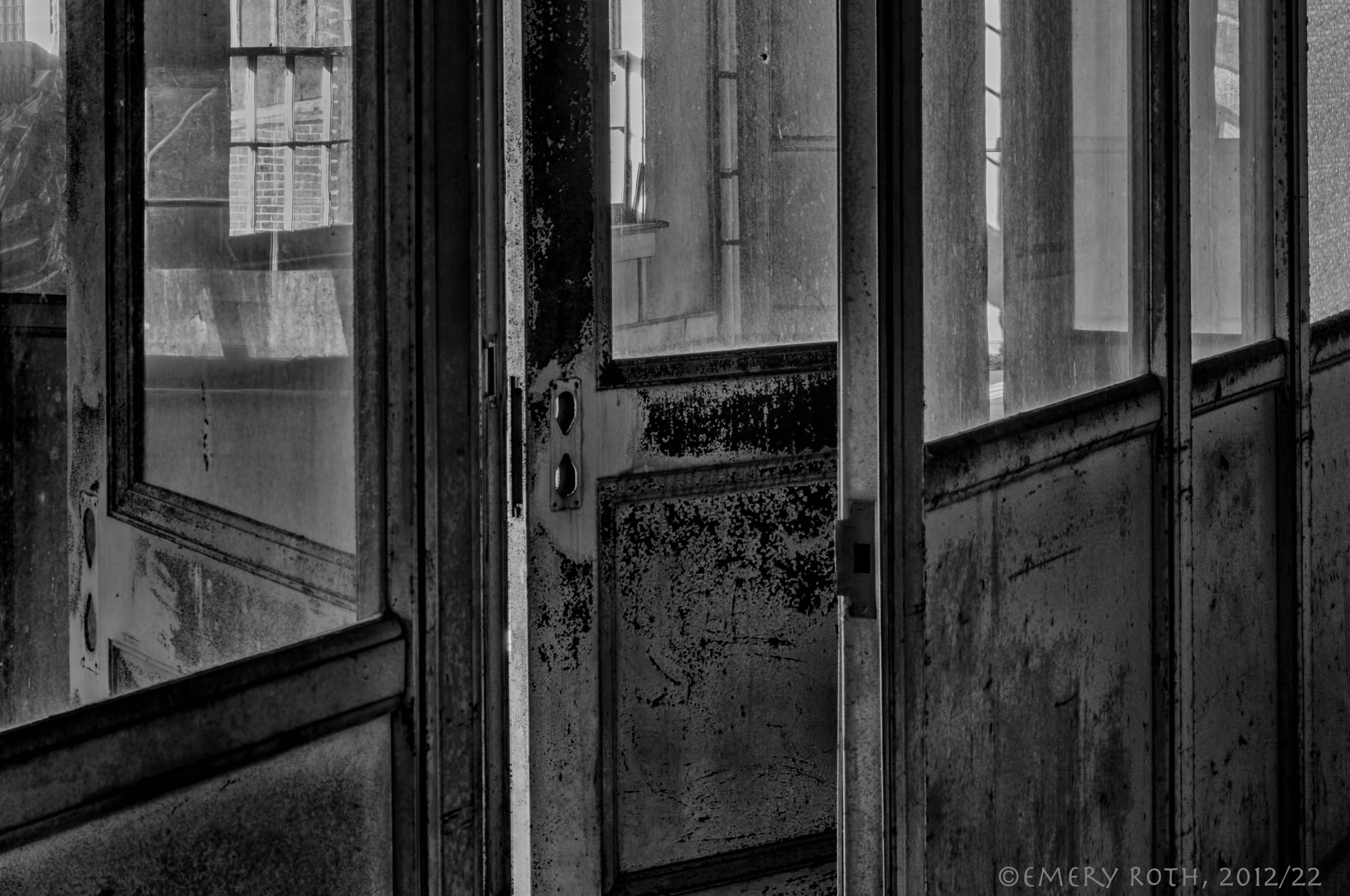
The Lampworks, once connected to other brick buildings of its era, was a survivior. The floors of the Lampworks were connected by two vertical stair towers and a an industrial freight elevator that I never saw used. The stair tower on the southeaster corner of the building, half-hidden in the picture, had a simple pitched roof and contained doors fastened shut that once led to buildings that had vanished and left no trace. 
 
The tower on the west side of the Lampworks had an elegant, 1880, pointed Victorian, slate, tower roof with tiny dormers that were owned by the pigeons, and it was all feathers and guano. 
 
Brick work at the northern end of the tube mill complex and a similar pointed tower, just visible over the tube mill roof, is a reminder of buildings that had stood between that were replaced around WW1 by the tube mill.

But that's all there is. Minor White properly asks what else might it be?

Tuesday, August 9, 2022

Lampworks 6 — Alternate Takes

Ansel Adams famously said that the negative was the score, the print was the orchestration. I offer two alternate interpretations of this photo of the Lampworks. Exploring possibilities.


Thursday, August 4, 2022

Lampworks 5 — Analog Spam

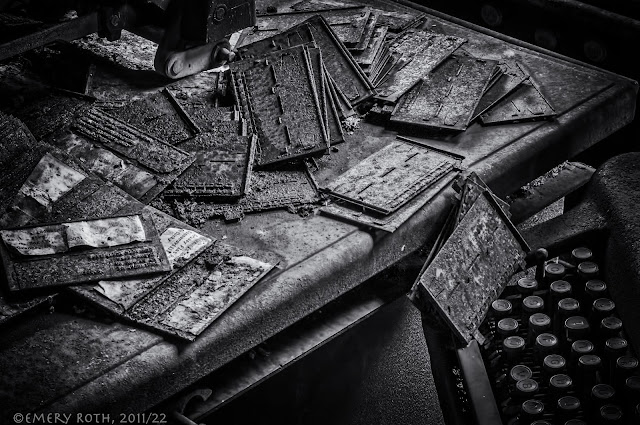
This Graphotype machine was all that remained to indicate what went on in the offices on the third floor of the Lampworks. It may look old and frail, but when two of us tried to nudge it into a more photogenic position, it would not budge. Even the movers who had emptied the partitioned offices had given up and left the iron Graphotype machine holding the floor — Just as it had held the floor when it automated spam and even as we started hearing, “You’ve got mail,” 80 years later and began receiving robocalls.

Graphotype is the companion machine to the Addressograph. The Graphotype machine allowed operators here to stamp the address, one laborious letter at a time, of a customer onto a metal card about the size of a credit card. A stack of such cards, the mailing list of customers, would have been stored in cartridges (a data base in a box). When run through an Addressograph machine each metal card would be inked and the address of each customer quickly stamped on a mailing label. During WW2 nearly 19 million dog tags were made with the Graphotype technology to help sort the wounded and dead. Early credit cards were called “charge plates,” and were made similarly. In the Lampworks the cascading rusted plates hold only the customers of a defunct metals company, even as the light deflecting and multiplying through hazy glass office partitions flashes occasionally the silhouettes of clerks rushing another solicitation.

The Addressograph was patented by Joseph Smith Duncan in 1896 after he had exhibited it at the great 1893, Chicago Worlds Fair. Commercial production and sale of the technology began in 1917.


Wednesday, August 3, 2022

Tuesday, August 2, 2022

Sunday, July 31, 2022

Lampworks, Waterbury, Customer Service

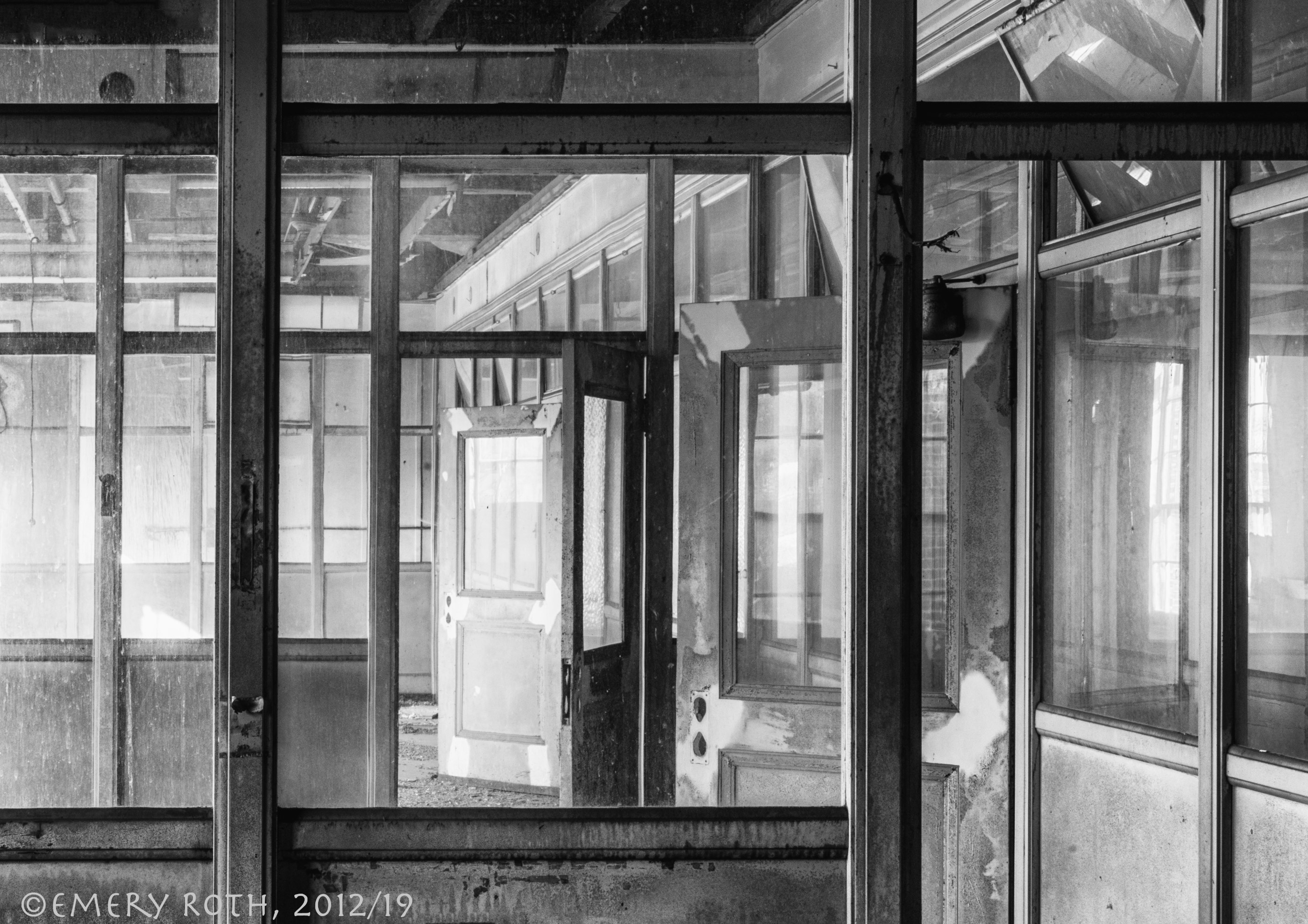
Although built in the dimly lit 19th century by Holmes, Booth & Haydens to manufacture oil lamps, only the first floor was still used when I began making photographs here. At that time in an adjacent shed men still ran giant presses and ovens to produce large diameter, metal tubing used in submarines. It was all supposed to be top secret, and the old lampworks added a look of abandonment to the active tube mill. On the first floor of the lampworks a well-equipped machine shop kept the tube mill running, but the three floors above were vacant. Each floor seemed like a different universe to be photographed. The second, with windows only on one side, was dark and grimy and littered with parts, and the 4th floor attic belonged to the pigeons, but the third floor, with a suite of offices divided by glass partitions, was a photographic kaleidoscope of shadows and reflections that moved with the sun. The offices shared a common space that still had an ancient Graphotrype spewing rusting address plates into a pile of forgotten customers.

See also:
    https://rothphotos.blogspot.com/2018/08/lamp-works-rip.html)
    https://rothphotos.blogspot.com/2015/04/attic-pigeons.html
or type “lampworks” in the search window.


Thursday, July 14, 2022

Wednesday, July 13, 2022

Monday, July 11, 2022

A Torrington Company Tour

From above it seemed quite orderly. Satellite photos show perhaps seven long sheds with east-west axes that begin in the west at a ribbon of courtyards and end in the east at a multi-story work shed. Most of buildings between were put place between 1906 the early 1920s. The interior sheds are mostly one story, and all are crowded together and stingy with the light delivered mostly through roof monitors and skylights, many boarded over. Our path was often through darkness, sometimes shattered by lens flaring brightness, and when possible to a forlorn glow and glimmer or the splendor of luminous, spaces carried on columns still marching, hollow and silent where machines no longer keep time, classical spaces that shout emptiness and paint left to its peeling.


We end where we began.

Saturday, July 9, 2022

Torrington Company Rumblings

The first sheds of the Torrington Company were built in 1906, two long brick structures that were connected midway in the form of an “H”. It is not clear to me how these initial structures became incorporated into the airless, mass of sheds that remain today, but I'm sure they're there and that I've passed through them. 

The brightly lit shed in the middle of this picture has a concrete inset above the entrance saying, “1912.” That was also the year in which the company's initial steam-driven, belt and rope system was replaced by an Allis Chalmers engine and generator providing the enterprise with 440-prime-volt current, power which did not come on wire poles. 1912, a pivotal year! The world was electrifying and thereby creating increased demand for all the things that made wheels spin. Additional sheds were also added at that time. The Balkans rumbled.

Thursday, July 7, 2022

The Torrington Company — 2

Does photographic beauty lie in the subject photographed or in the photograph itself?

Photographs such as this remind me of the compositional rigor that seems to drive my enjoyment of photography. For me, every photograph poses the question of the rectangle. How will it be cast over the forms that attract me? The viewers' eyes must be drawn along an interesting path that syncs the picture’s tempo, tensions, mood, and that makes the rectangle whole and complete. 

How the photograph is “finished,” is, as Ansel Adams, who played Bach’s Inventions on a piano, tells us, merely orchestration, and the original negative or RAW file is the score which can be re-orchestrated at any time. Digital technology has vastly changed the nature of orchestrating and displaying digital photographs.


Monday, July 4, 2022

The Standard Plant, Torrington Company

Even with a flashlight, it took a few seconds for our eyes to penetrate the murky darkness that extended like a mine shaft into a sequence of factory sheds indifferently spotted with the light from broken roof monitors. Variously, passages connected to similar sheds left and right, some glowing, others black as a crypt and all empty down to the walls and vacant. What went on here?

I’ve learned the first of the sheds was built in 1906 to house a spinoff of the Excelsior Needle Company (see: New England Pin Co. No.2). These buildings would serve the newly formed Standard Spoke and Nipple Company. Motor cars were still gadgets, but bicycles had become practical and popular, high-speed transportation requiring strong legs but neither hay nor barn. The new sheds would have been filled with machine tools strung together by belts and ropes to a hungry steam engine and the workers who knew how to use these to make products that wound include not just needles, bicycle pedals and handlebars, but metal tubing, machine screws, carpet sweepers, piano hardware, ball bearings, eventually spark plugs as well as bicycle spokes and nipples. At its peak the Torrington Company’s Standard Plant, as it would be known after 1917, would employ more than 1000 workers, tho nobody has worked here for 2 or 3 decades.