
Thursday, September 1, 2022

Thursday, August 11, 2022
Lampworks 8 — The Machine Shop

In a well-equipped
machine shop on the first floor of the Lampworks a team of machinists
kept machines running to fulfill the last order for tubes from the tube
presses in the neighboring shed.

.jpg)
Machining is, arguably, the signature skill of the industrial age as programming is of our digital times. Does such human re-wiring change us?
Wednesday, August 10, 2022
Lampworks 7 — Remembering Stair Towers
 |
| Holmes, Booth & Haydens Lampworks, 2011 (from the southwest) |
 |
| Interior, western tower |
 |
| Interior, southeastern tower |
Where
is the line between art and documentation? Labels. These photographs
fail to reach Minor White's "What else is it?" criterion except within
the prose of the whole experience. Yet I stopped often at that wheeled
hamper thinking how photogenic it was and then failed to shoot.
The
Lampworks, once connected to other brick buildings of its era, was a
survivior. The floors of the Lampworks were connected by two vertical
stair towers and a an industrial freight elevator that I never saw used.
The stair tower on the southeaster corner of the building, half-hidden
in the picture, had a simple pitched roof and contained doors fastened
shut that once led to buildings that had vanished and left no trace.
The
tower on the west side of the Lampworks had an elegant, 1880, pointed
Victorian, slate, tower roof with tiny dormers that were owned by the
pigeons, and it was all feathers and guano.
Brick
work at the northern end of the tube mill complex and a similar pointed
tower, just visible over the tube mill roof, is a reminder of buildings
that had stood between that were replaced around WW1 by the tube mill.
Tuesday, August 9, 2022
Lampworks 6 — Alternate Takes
Ansel Adams famously said that the negative was the score, the print was the orchestration. I offer two alternate interpretations of this photo of the Lampworks. Exploring possibilities.


Thursday, August 4, 2022
Lampworks 5 — Analog Spam
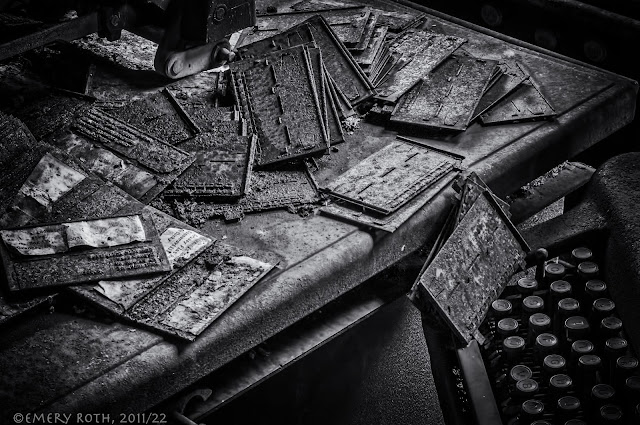
This Graphotype machine was all that remained to indicate what went on in the offices on the third floor of the Lampworks. It may look old
and frail, but when two of us tried to nudge it into a more photogenic
position, it would not budge. Even the movers who had emptied the
partitioned offices had given up and left the iron Graphotype
machine holding the floor — Just as it had held the floor when it
automated spam and even as we started hearing, “You’ve got mail,” 80 years later and
began receiving robocalls.
Graphotype is the companion machine to the Addressograph. The Graphotype machine allowed operators here to stamp the address, one laborious letter at a time, of a customer onto a metal card about the size of a credit card. A stack of such cards, the mailing list of customers, would have been stored in cartridges (a data base in a box). When run through an Addressograph machine each metal card would be inked and the address of each customer quickly stamped on a mailing label. During WW2 nearly 19 million dog tags were made with the Graphotype technology to help sort the wounded and dead. Early credit cards were called “charge plates,” and were made similarly. In the Lampworks the cascading rusted plates hold only the customers of a defunct metals company, even as the light deflecting and multiplying through hazy glass office partitions flashes occasionally the silhouettes of clerks rushing another solicitation.
The Addressograph was patented by Joseph Smith Duncan in 1896 after he had exhibited it at the great 1893, Chicago Worlds Fair. Commercial production and sale of the technology began in 1917.
.jpg)
.jpg)
.jpg)
Wednesday, August 3, 2022
Tuesday, August 2, 2022

Sunday, July 31, 2022
Lampworks, Waterbury, Customer Service
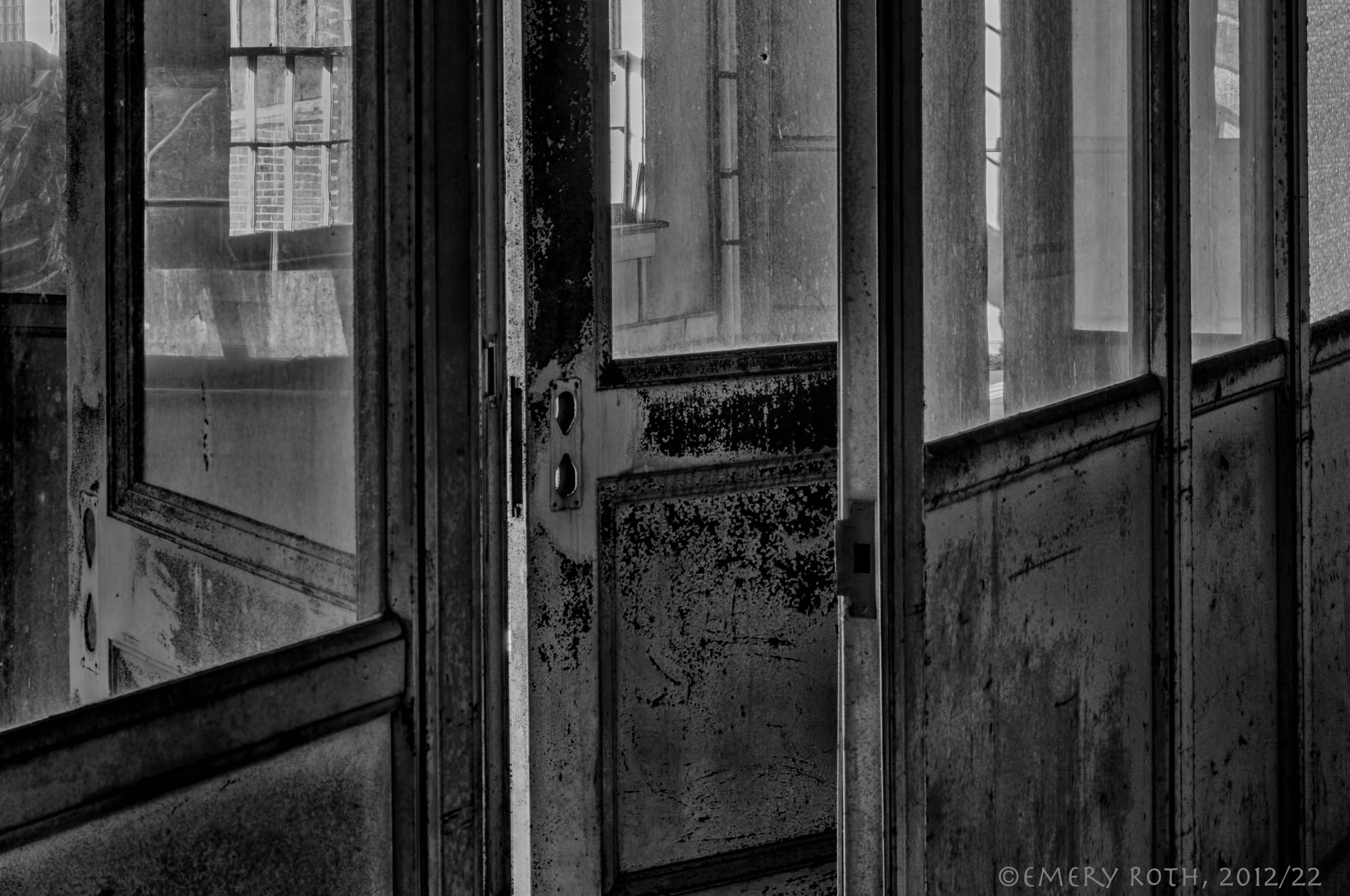
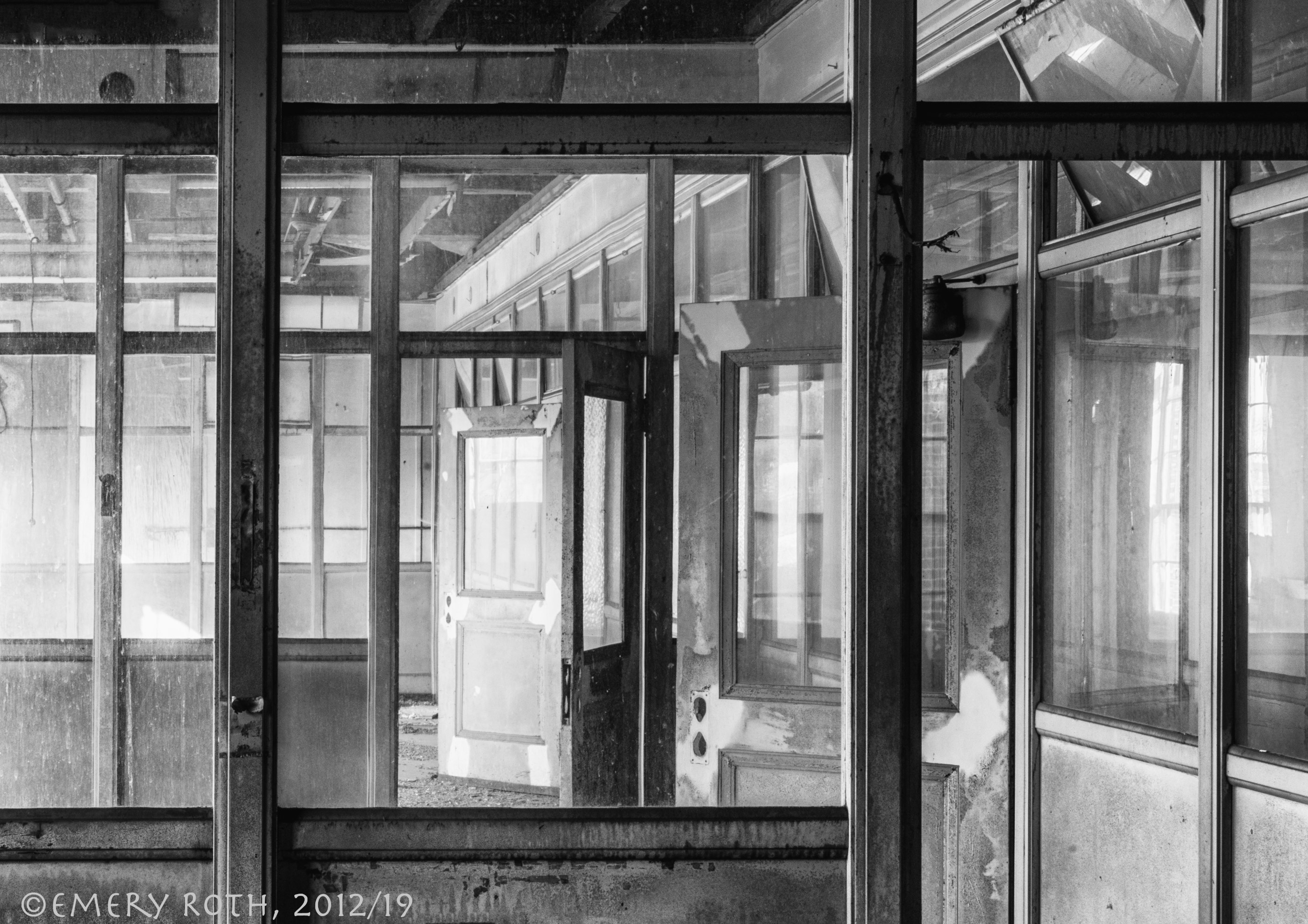
Although built in the dimly lit 19th century by Holmes, Booth & Haydens to manufacture oil lamps, only the first floor was still used when I began making photographs here. At that time in an adjacent shed men still ran giant presses and ovens to produce large diameter, metal tubing used in submarines. It was all supposed to be top secret, and the old lampworks added a look of abandonment to the active tube mill. On the first floor of the lampworks a well-equipped machine shop kept the tube mill running, but the three floors above were vacant. Each floor seemed like a different universe to be photographed. The second, with windows only on one side, was dark and grimy and littered with parts, and the 4th floor attic belonged to the pigeons, but the third floor, with a suite of offices divided by glass partitions, was a photographic kaleidoscope of shadows and reflections that moved with the sun. The offices shared a common space that still had an ancient Graphotrype spewing rusting address plates into a pile of forgotten customers.
See also:
https://rothphotos.blogspot.com/2018/08/lamp-works-rip.html)
https://rothphotos.blogspot.com/2015/04/attic-pigeons.html
or type “lampworks” in the search window.

Saturday, July 16, 2022
Thursday, July 14, 2022
.jpg)
.jpg)
.jpg)
Wednesday, July 13, 2022

Monday, July 11, 2022
A Torrington Company Tour
From above it seemed quite orderly. Satellite photos show perhaps seven long sheds with east-west axes that begin in the west at a ribbon of courtyards and end in the east at a multi-story work shed. Most of buildings between were put place between 1906 the early 1920s. The interior sheds are mostly one story, and all are crowded together and stingy with the light delivered mostly through roof monitors and skylights, many boarded over. Our path was often through darkness, sometimes shattered by lens flaring brightness, and when possible to a forlorn glow and glimmer or the splendor of luminous, spaces carried on columns still marching, hollow and silent where machines no longer keep time, classical spaces that shout emptiness and paint left to its peeling.


 |
| We end where we began. |
Saturday, July 9, 2022
Torrington Company Rumblings

The first sheds of the Torrington Company were built in 1906, two long brick structures that were connected midway in the form of
an “H”. It is not clear to me how these initial structures became
incorporated into the airless, mass of sheds that remain today, but I'm
sure they're there and that I've passed through them.
The brightly lit shed in the middle of this picture has a concrete inset
above the entrance saying, “1912.” That was also the year in which the
company's initial steam-driven, belt and rope system was replaced by an
Allis Chalmers engine and generator providing the enterprise with
440-prime-volt current, power which did not come on wire poles. 1912, a
pivotal year! The world was electrifying and thereby creating increased
demand for all the things that made wheels spin. Additional sheds were also
added at that time. The Balkans rumbled.
Thursday, July 7, 2022
The Torrington Company — 2
Does photographic beauty lie in the subject photographed or in the photograph itself?
Photographs such as this remind me of the compositional rigor that seems to drive my enjoyment of photography. For me, every photograph poses the question of the rectangle. How will it be cast over the forms that attract me? The viewers' eyes must be drawn along an interesting path that syncs the picture’s tempo, tensions, mood, and that makes the rectangle whole and complete.
How the photograph is “finished,” is, as Ansel Adams, who played Bach’s Inventions on a piano, tells us, merely orchestration, and the original negative or RAW file is the score which can be re-orchestrated at any time. Digital technology has vastly changed the nature of orchestrating and displaying digital photographs.

Monday, July 4, 2022
The Standard Plant, Torrington Company
Even with a flashlight, it took a few seconds for our eyes to penetrate the murky darkness that extended like a mine shaft into a sequence of factory sheds indifferently spotted with the light from broken roof monitors. Variously, passages connected to similar sheds left and right, some glowing, others black as a crypt and all empty down to the walls and vacant. What went on here?
I’ve learned the first of the sheds was built in 1906 to house a spinoff of the Excelsior Needle Company (see: New England Pin Co. No.2). These buildings would serve the newly formed Standard Spoke and Nipple Company. Motor cars were still gadgets, but bicycles had become practical and popular, high-speed transportation requiring strong legs but neither hay nor barn. The new sheds would have been filled with machine tools strung together by belts and ropes to a hungry steam engine and the workers who knew how to use these to make products that wound include not just needles, bicycle pedals and handlebars, but metal tubing, machine screws, carpet sweepers, piano hardware, ball bearings, eventually spark plugs as well as bicycle spokes and nipples. At its peak the Torrington Company’s Standard Plant, as it would be known after 1917, would employ more than 1000 workers, tho nobody has worked here for 2 or 3 decades.


.jpg)
Saturday, July 2, 2022
Washington Street Bridge
Iron bridges spanned the era between wood and steel. Those like the one on Washington Street are sometimes called “Pumpkin Seed” or “Bow String” bridges and were built throughout New England and beyond by the Berlin Iron Bridge Company. Officially known as lenticular truss bridges, they follow principles of a patented, “parabolic, lenticular, truss design employing paired elliptical arches connected at the ends and cross-braced between. The trusses which carried the loads used cast iron for compression members and wrought iron for tension. Berlin Iron and Bridge would build nearly 400 lenticular truss bridges throughout New England, NY, NJ, PA and as far away as Texas. The Washington Street bridge, built in 1879 when Berlin Bridge Company was still called the Corrugated Metal Company, is thought to be the earliest of them.
Interesting info here: http://next.owlapps.net/owlapps_apps/article?id=67923819&lang=en
.jpg)
Monday, June 27, 2022
The Mad River, Waterbury
The Mad River follows a ravine between Mill Street and River Street in Waterbury, CT, through what looks like a park but whose chain link border is a legacy of its toxic history. The river flows under two bridges beside where South Main crosses Washington Street, moments before its waters blend with those of the Naugatuck. The view is upstream from the historic, 1881, iron bridge on Washington Street across a modern highway bridge on South Main. Once this was the center of acres of furnaces and factories making the metal that would become buttons and pins, oil lamps, clocks, bullet casings and tea kettles. It’s a busy intersection of roads and rivers with an awkward jog put in place when traffic was horse-drawn wagons and laborers trudging to and from work in shifts.
The odd intersection isolates a tiny, right triangle of real estate with legs along the crossing avenues and a Mad River hypotenuse. It is a site almost too small for a building, but a four story apartment house known as “The Louis Block" has stood there since 1890 with balconies buttressed out over the river to make its narrow plot more commodious. Delicate brick work on the front (not shown) of the Louis Block have caused speculation that it might be the work of Robert Wakeman Hill, sometimes called CT’s “State Architect.” Across the river from the Louis Block several bays of train trestle, hidden behind the foliage, are all that’s left of a timber structure that crossed here carrying rumbling, puffing freight loads of manufactured goods and raw materials through the Mad River Ravine.
The Waterbury Companies was founded by Aaron Benedict to make military buttons for the War of 1812. It grew to be the Benedict & Burnham Brass Company making buttons, clocks and eventually making injection molded plastic parts. The Waterbury Companies is still making buttons that stylishly supply clothiers such as Ralph Lauren and Brooks Brothers.
The iron bridge is the work of the Berlin Iron Bridge Company which also fabricated steel to build the historic Farrel Foundry downstream in Ansonia.

from Washington Street upstream on the Mad River

up the Mill Street - River Street Ravine


Looking across S. Main St., down Washington St. to the iron bridge
Saturday, June 25, 2022

Tuesday, June 21, 2022

Saturday, June 18, 2022
.jpg)
Friday, June 17, 2022
...continuing the journey now to 2014 and once more reversing the view (see previous post) on the vacant Benedict & Burnham lot: The corner of the powerhouse is in the foreground. The offices are on the right, and the building in the center blocks our view of the other shed that stood on what is now the vacant plaza. The stair tower at its corner was structurally sound at the time, but leaks had rotted floor boards between the tower and the work floors at the heart of gloom which were bare.

Subscribe to:
Posts (Atom)


