![]() |
| Holmes, Booth & Haydens Lampworks, 2011 (from the southwest) |
![]() |
| Interior, western tower |
![]() |
| Interior, southeastern tower |
![]() |
| Holmes, Booth & Haydens Lampworks, 2011 (from the southwest) |
![]() |
| Interior, western tower |
![]() |
| Interior, southeastern tower |
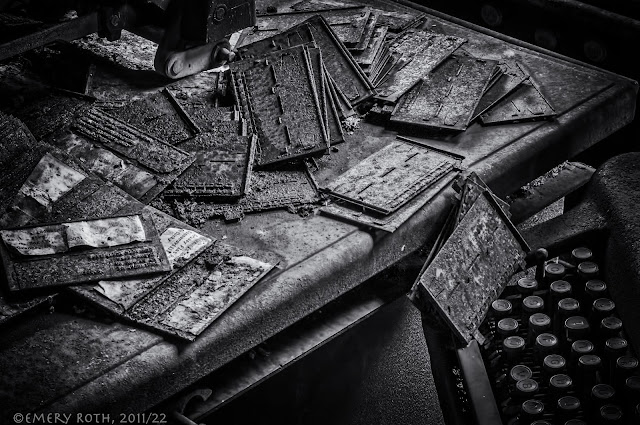
This Graphotype machine was all that remained to indicate what went on in the offices on the third floor of the Lampworks. It may look old
and frail, but when two of us tried to nudge it into a more photogenic
position, it would not budge. Even the movers who had emptied the
partitioned offices had given up and left the iron Graphotype
machine holding the floor — Just as it had held the floor when it
automated spam and even as we started hearing, “You’ve got mail,” 80 years later and
began receiving robocalls.
Graphotype is the companion machine to the Addressograph. The Graphotype machine allowed operators here to stamp the address, one laborious letter at a time, of a customer onto a metal card about the size of a credit card. A stack of such cards, the mailing list of customers, would have been stored in cartridges (a data base in a box). When run through an Addressograph machine each metal card would be inked and the address of each customer quickly stamped on a mailing label. During WW2 nearly 19 million dog tags were made with the Graphotype technology to help sort the wounded and dead. Early credit cards were called “charge plates,” and were made similarly. In the Lampworks the cascading rusted plates hold only the customers of a defunct metals company, even as the light deflecting and multiplying through hazy glass office partitions flashes occasionally the silhouettes of clerks rushing another solicitation.
The Addressograph was patented by Joseph Smith Duncan in 1896 after he had exhibited it at the great 1893, Chicago Worlds Fair. Commercial production and sale of the technology began in 1917.
See also:
https://rothphotos.blogspot.com/2018/08/lamp-works-rip.html)
https://rothphotos.blogspot.com/2015/04/attic-pigeons.html
or type “lampworks” in the search window.
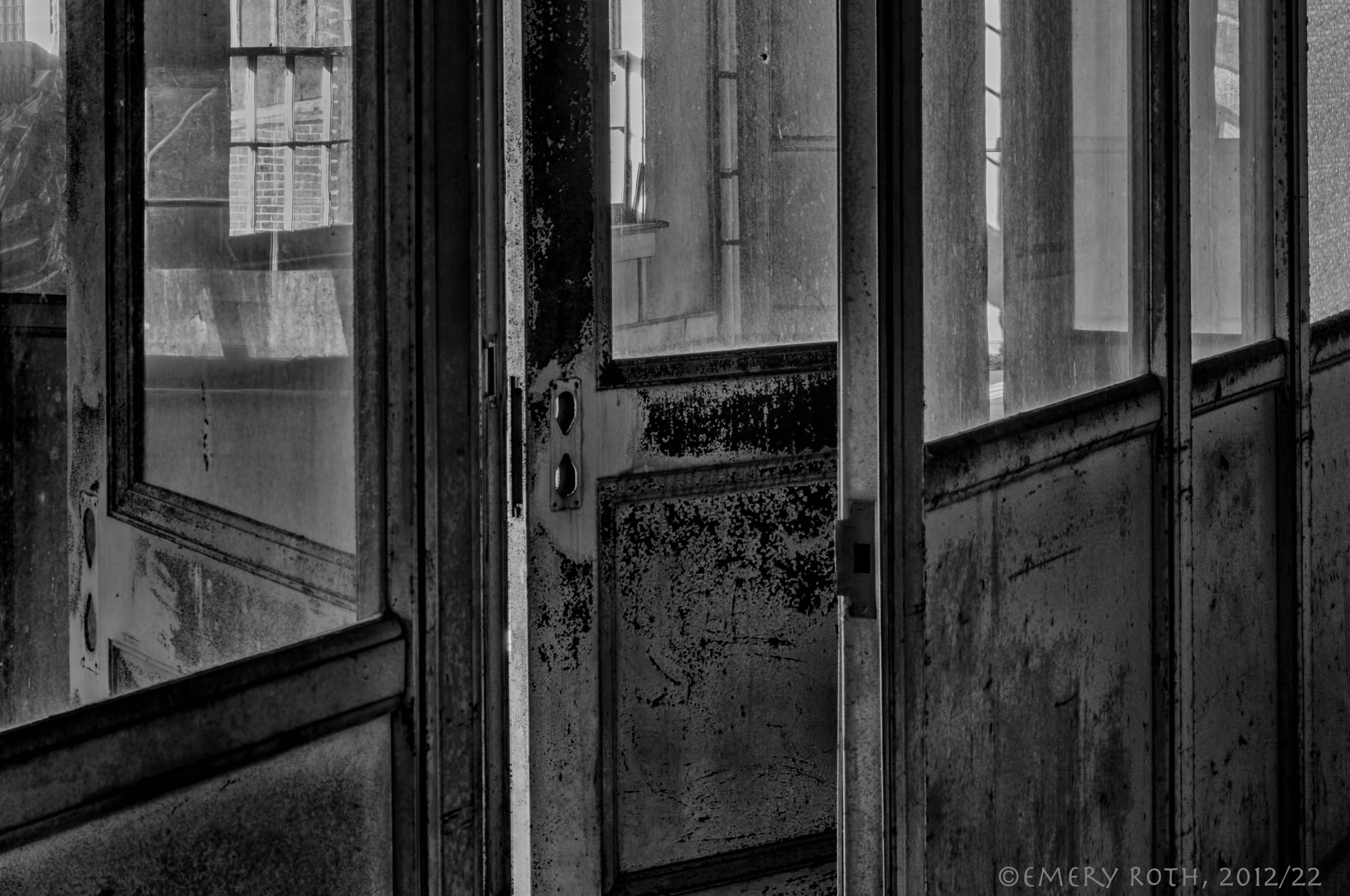
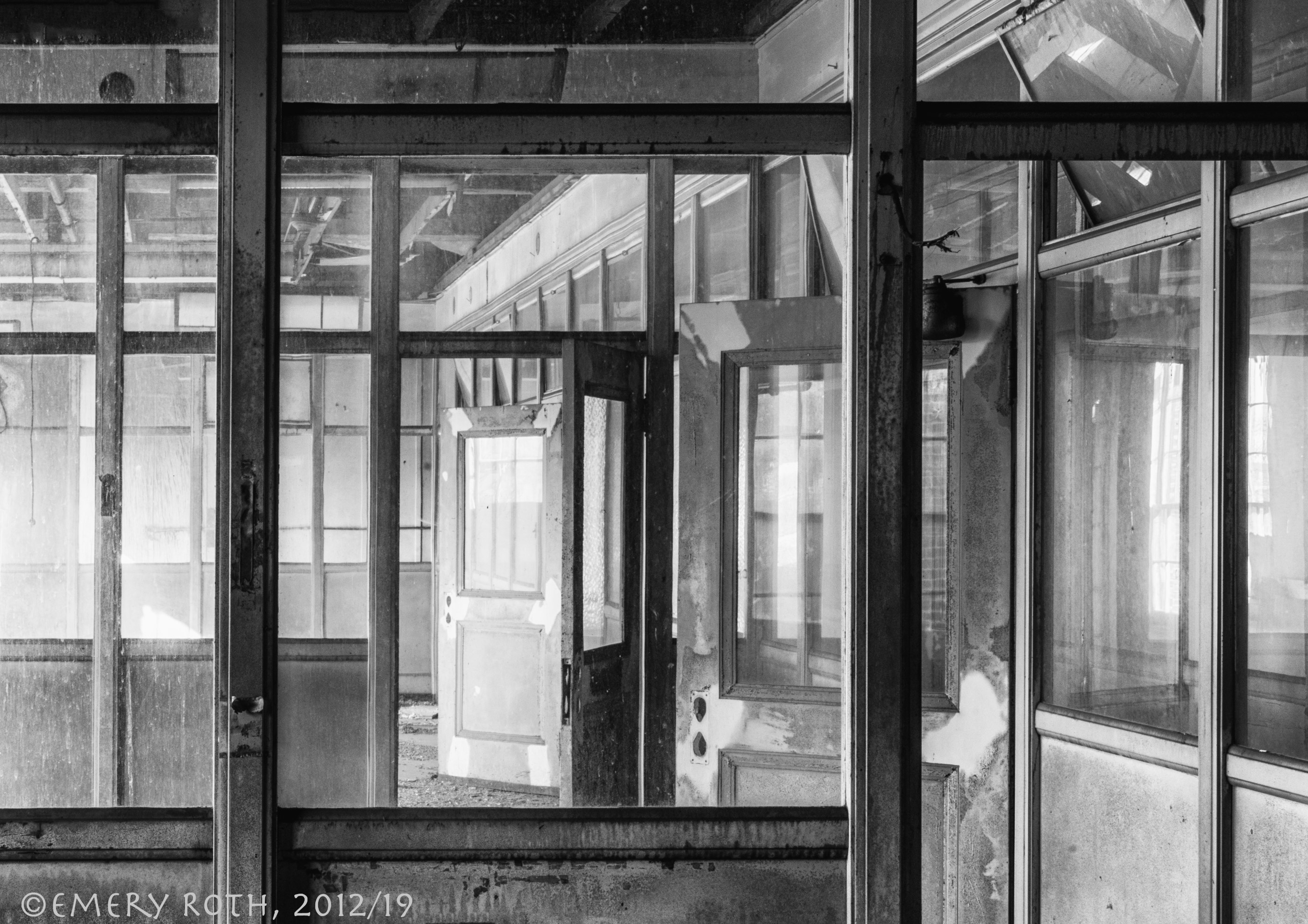
From above it seemed quite orderly. Satellite photos show perhaps seven long sheds with east-west axes that begin in the west at a ribbon of courtyards and end in the east at a multi-story work shed. Most of buildings between were put place between 1906 the early 1920s. The interior sheds are mostly one story, and all are crowded together and stingy with the light delivered mostly through roof monitors and skylights, many boarded over. Our path was often through darkness, sometimes shattered by lens flaring brightness, and when possible to a forlorn glow and glimmer or the splendor of luminous, spaces carried on columns still marching, hollow and silent where machines no longer keep time, classical spaces that shout emptiness and paint left to its peeling.
Iron bridges spanned the era between wood and steel. Those like the one on Washington Street are sometimes called “Pumpkin Seed” or “Bow String” bridges and were built throughout New England and beyond by the Berlin Iron Bridge Company. Officially known as lenticular truss bridges, they follow principles of a patented, “parabolic, lenticular, truss design employing paired elliptical arches connected at the ends and cross-braced between. The trusses which carried the loads used cast iron for compression members and wrought iron for tension. Berlin Iron and Bridge would build nearly 400 lenticular truss bridges throughout New England, NY, NJ, PA and as far away as Texas. The Washington Street bridge, built in 1879 when Berlin Bridge Company was still called the Corrugated Metal Company, is thought to be the earliest of them.
![]() |
| South Main Street Looking South to St. Francis Xavier Church |
![]() |
| South Main Street Looking North to St. Anne's Church |