Monday, October 8, 2012

The Idea of Galapagos


PHOTOGRAPHER'S JOURNAL:  If you have thought about Galapagos at all, it is likely that before it was a place, it was an idea. As I have read and thought about it for a little while, the idea has become more distinct and multifaceted. First came the name and its reference to sentient creatures, the tortoises who some think may live as much as 500 or 1000 years. That is long enough for all of Mayan, Aztec, and Inca civilizations to have come and passed. That is one scale on which I measure my Galapagos.

Despite strong evidence to the contrary, my Galapagos is a pristine archipelago set far apart from continental traffic and trends. It is a place where volcanic islands are still rising from the ocean, floor, borne on a bulging hotspot in the earth's crust which each island will ride back into the sea in an arc of time. Each island from oldest to youngest, children of the sea, is distinct though a recognizable member of a family. My archipelago explodes with diversity and abundance, free of threats from outside.

Because each island owes its origin to different volcanic events over a vast stretch of time, each island is a unique habitat. Famously, Darwin observed species here and found species of finches that were endemic, not only to the archipelago as a whole, but to specific islands within it, with differences reflecting each island's habitat. Thus Galapagos became the land that confirmed species mutability, challenging the notion that creation was over, accomplished, complete. My Galapagos is a place where the world is continually being made new, a place where we are only visitors to a finite world looking for an escape to eternity.


Thursday, October 4, 2012

Quito from the Mountaintop


Rizbuth "The universe is apparently a self-creating entity. We were engineered by the environment of which we are part, preceded only by an impulse to be, the source and trajectory of which remain unrevealed, at best, conjectural."


PHOTOGRAPHER'S JOURNAL: 

Of Wheels and Weaves

Wheels spin 
like time itself 
shuttling tourists,
the Teleferico  -
built to showcase 
a local culture 
a country,
a genius,
to worldwide markets, 
turning cables,
spinning Inca, 
Colonial, 
Modern 
into global fabric 
still evolving 
on shifting techtonics,
as we plunge back to Quito
with whatever we have learned.


Wednesday, October 3, 2012

Cabled from the Mountaintop


PHOTOGRAPHER'S JOURNAL:  Back in the terminal the wheels were still at their cadences beginning with a whoosh as the doors close - eleven seconds whirring followed by pulses, throbs, double-thump, whoosh and silence as I imagined parallel sets of tourists issuing from the gondolas, one side coming, the other going, and cadences, gondolas every thirty seconds, the wheels forever turning. 

In reality, only a few other visitors were there when we were there, and most of the gondolas went through empty. Even so, it was hard not to pause each time the cadence reached the double-thump, whoosh, and at the silence look for the invisible families streaming up and down the mountain in even-cadenced rhapsody. I had a few moments to take it all in before we joined the line and rode the cable back from the volcanic frontier, where continents collide along the ring of fire, to the wheels and deals of Quito.


Monday, October 1, 2012

Frontier


FEDERICO FELLINI:  "What is an artist? A provincial who finds himself somewhere between a physical reality and a metaphysical one.... It's this in-between that I'm calling a province, this frontier country between the tangible world and the intangible one - which is really the realm of the artist."


PHOTOGRAPHER'S JOURNAL:   There are many truths at the tops of mountains, and the first is that the top is always further off and higher up than it seemed along the way. We never got there and turned back toward the city. Another truth for me is that the thrill, the rush, the ecstasy comes as much from the remoteness of the mountaintop as from its elevation.  We were beside a major city. We had arrived in a gondola made to carry bicycles at a terminal where vacant store fronts begged for tenants!  

We had, however, crossed a significant edge the moment we stepped beyond the terminal and we thrilled looking over it. It was certainly an edge, even a, "frontier," to a notoriously rugged and lonely stretch of roadless, volcanic, Andean highlands; a frontier if one accepts that terrestrial frontiers are now all encircled by roads and photographed from space and available on your Google desktop. No need to stand on a mountaintop to feel the earth shifting beneath our feet, however good it felt to actually go there and feel it push up on the soles of our shoes. Perhaps the real frontiers today are all in time.


Sunday, September 30, 2012

Pichincha Volcano High


PHOTOGRAPHER'S JOURNAL: 


The True Pichincha

Of course the cable had an end, 
but the mountain went on, 
the top, not top at all,
a plain of raw thatch,
empty spaces, 
distant outcrops,
under the cloud garden ,
and approaching storm; 
beneath its pall, 
they tell me, 
the true Pichincha.


Friday, September 28, 2012

Quito from Stanchion #13


PHOTOGRAPHER'S JOURNAL:  Like Cuzco, Quito is set in a broad Andean plain. It is surrounded by high mountains. It was to get on the top of one of these that we were dangling from a wire in a plastic bubble that swung gently as it rose.  We looked back as people disappeared, then the forms of buildings disappeared, then the city was reduced to bright texture, the fabric of a culture consuming the plain. How long was the wire? -the end still not in sight  -perhaps infinite at both ends!  What new wisdom to gain from one more trip to the mountaintop?


Thursday, September 27, 2012

Portrait of Quito from the Plaza of the Chapel of Man


PHOTOGRAPHER'S JOURNAL:  When we arrived in Quito neither Jane nor I had heard of Oswaldo Guayasamin. I took it as a sign of my ignorance, but I'm learning it is an ignorance widely shared in the English-speaking world. I don't know why. His paintings are visceral and feel authentic, emanating like music from the Quechua culture in which he grew up. They seem natural companions to works by Picasso and Diego Rivera and others.  

The Chapel of Man is a large, circular exhibition space surrounding an eternal flame and topped with a decorated cupola. It was designed by Guayasamin (trained as an architect) to hold and display his paintings.  The scale of the works and the space and the silence inside is expansive. That silence surrounds giant faces and hands that wait, hope, pray, cringe, yearn, rage, console, sometimes wail silently from all around us. It is painting on the scale of grand opera. It is soulful music.

After the gift shop we found ourselves back out on the plaza of the Chapel of Man, and this was our view over Quito, close enough to touch and big enough to get lost in.


Tuesday, September 25, 2012

Wired Quito


PHOTOGRAPHER'S JOURNAL: Quito is a beautiful city choked by traffic. Our visit was brief, and much of what we saw of the cityscape came to us through car windows as we toured neighborhoods and rode between wonderful places where no photographs were permitted. In "the betweens," I snapped wildly in frustration while Diego, our driver, bumped us forward along clogged boulevards or elbowed us into honking intersections where only the fittest survived. We're grateful for his talents and thankful neither of us was behind the wheel. Diego knew shortcuts and sometimes we'd break free onto a side street, race around a corner, and we'd be winding up over the hillsides as if lifted above traffic up with the air and the clear mountain light and the city's bright colors and gleaming new apartment towers.  

Our hotel was a place of quiet amid the bustling city. A porter had to unlock stout, wood doors every time we left, and when we returned we had to buzz for the porter to let us in. On our first evening there, we found a spiral stair that led to a kind of loft-room above the third floor and offered a rooftop panorama. Other buildings had similar aeries with rooftop vistas so that even bottom feeders could grab some top air. Sitting in the aerie, we looked up at La Panecillo with its giant, white statue of La Virgin de Quito lit amid the night clouds, almost as if she were hovering just above the city.

However, this photograph was snapped out of the back window of the car as we were about to turn a corner between where we were and where we were going. It was the clothes line in the upper right that caught my eye.  To make the composition, however, most of the laundry got cropped away.


NOTE: Jane and I were especially awed and dazzled by the beauty of La Campaña de Jesús and thankful to be introduced to the work of Guayasamin whose soulful paintings touched us deeply, but this is a photo blog and no photography was permitted there.   


Monday, September 24, 2012

Past Noon, Plaza de la Indepencia, Quito


TERRENCE McKENNA:  "Ideology always paves the way toward atrocity."


PHOTOGRAPHER'S JOURNAL:  If one knows the history, it's hard to look at monuments such as this one to, "the heroes of August 10th, 1809," in the Plaza de la Indepencia, in Quito Ecuador... hard to look at it without reflecting on the world today. (You can read about the events of August 10th here.

And further back in time's jungles, the events of our world and the struggles of 1809 seem linked to the day in 1539, a year after Pizarro had executed the Inca, Atahualpa, when Atahualpa's general razed Quito by setting fire to the Inca Palace, rather than surrender it to the conquistador, Almagro.  

However, the city already had a long history then. Won by Atahualpa's father Huayna Capac in his northward conquests, it had eventually become the home from which he ruled the Inca Empire, setting off wars of succession upon his death, between Atahualpa and his Cuzco-born half-brother; they were wars that left the Inca Empire divided just when it needed to be unified against the Spanish.

Tangible ruins of those times lie in the Inca foundations under the colonial buildings, but the city's name brings us further still to the struggles of the Quitua people who ruled here until conquered by Huayna Capac.  How are these spaceless Quitua halls connected to all of the other ruins through which our spirits wander?


Sunday, September 23, 2012

Una Via, Peguche


PHOTOGRAPHER'S JOURNAL:  We were in Peguche to buy a rug. What that has to do with the little man who accosted me in the square, I'm not sure. Perhaps they have no connection at all. In the Otavalo region many of the villages have taken on an identity attached to the particular craft cultivated by the native population there. We visited a village known for its leather-goods and then another for its woodworking. Although there was nothing I wanted, the beauty of the work and the vitality of the villages was inspiring. Raquel told us the villages in the area compete annually for awards to claim the title of best.

Peguche was where José Cotacachi, a weaver, had his studio. The trip had been worth it; his rugs were magical. Owning one would be a privilege.  I did my best to communicate that, and I wondered about his lack of responsiveness. I could read his demeanor as arrogant, timid or simply due to the gulf between our languages.  With Raquel's help I asked if I could photograph him at his loom, and he sat down and wove for a few minutes, but he avoided eye contact, had his attentions elsewhere; he wove the rows, it seemed, as if it was a ritual he felt obliged to submit to. Perhaps I misread the signals completely. Perhaps it was just late.

I especially wanted to communicate how beautiful his work was as we would not be buying one of the magical rugs I so admired. Their designs were filled with visual paradoxes and creatures that quickly reminded me of M.C. Escher, though his source was native imagery. Hanging about his studio they enlarged it, opening spaces behind the walls. Each was a new adventure. Jane and I were both impressed but a bit concerned that kind of spacial ambiguity might be unsettling underfoot. 

We had chosen a beautiful, though clearly inferior, rug at a lower price to spread in our dining room. It would be the sole, lasting, tangible artifact of our travels in Ecuador and Peru, and we would treasure it for itself and for its connection to this beautiful studio. I wanted to communicate that and my admiration for the weaver's artistry and to maybe learn a bit about what moved him, but by the time Raquel was closing the deal, I knew that would be impossible. I'm not sure why.  I retreated to the plaza where there had been some photo ops, and I left Jane to see things through.

It was an ugly little square, "Plaza Cultural," they called it, dominated by a one-story church whose facade reached up in flat imitation of a belfry with an opening in which were hung two tiny bells that seemed capable of little more than tinkling. Two columns in a style best described as Las Vegas Greek surrounded what could never be called the portal, and the whole silly facade was crowned with a cross.  I really wanted to photograph some large, black ovens along one side of the square and the ancient women dressed in black who were busy there, but it seemed improper to photograph the women without speaking with them first. Jane would be out momentarily, and it was getting late. If communication was even possible, it would involve more time than we had left; tempting as it was, I would not photograph the crones at their labor.

Some young girls, barely teens, passing through the square, posed saucily, tried to get me to take their pictures. They would probably ask for money.  In any case, engaging seemed unwise. As I turned, the barefoot man waved to me. He wanted my attention. He pointed to the belfry and made the sign of the cross as he tried to speak.  He kept opening his mouth, urgently trying to tell me something, but no sounds came out. He was insistent. What did he want me to do? He kept pointing, mouthing wordlessly. I smiled and tried to make a sign that I didn't understand, couldn't comply. I wanted to understand, but in the end, I changed the topic.  Could I take his picture.  He seemed happy to pose and happy to take the coins I gave him afterward.  I'm still struck by the brightness of his eyes, and I wonder what it was he would have said and how he fits into this world in which I'm such a stranger.

Tuesday, September 18, 2012

¿Este Sombrero?


PHOTOGRAPHER'S JOURNAL:  Raquel, our guide led us beyond vegetables through thickets of Quechua and Spanish and flashing calculators and the important distinctions of quality and inferior Panama crafting, until we finally closed a deal, shook hands and strutted away in our dapper, Ecuadorean Panamas. 

The Panama hats for the Galapagos cruise spent the voyage in steerage. Sailors that we are, we had not counted on wind at sea, and it's still not clear if the hats survived steerage.

Monday, September 17, 2012

Among Vegetables


PHOTOGRAPHER'S JOURNAL:  We were on a quest. We had read that, contrary to expectation, the best Panamas are made in Ecuador. Finally, we were in the best market in Ecuador, home of stylish headwear. Here, we thought, just beyond vegetables, were stalls where we would find two, suave, Ecuadorian Panamas for cruising the Galapagos.


Sunday, September 16, 2012

Thursday, September 13, 2012

Birdman of Otavalo No.2


SAMUEL TAYLOR COLERIDGE: 

"'God save thee ancient Mariner!
From the fiends, that plague thee thus! --
Why look'st thou so?'-- With my cross-bow
I shot the Albatross."


Friday, September 7, 2012

Blue Owl?


PHOTOGRAPHER'S JOURNAL: What a magnificent looking creature! Alas, the presentation was in Spanish only. Does anyone know what kind of bird this is? 

Parque Condor's mission is to educate the public about the environment. As an example, they explain, "The role of vultures that feed on dead animals is to clean the ecosystem and prevent pollution. If we kill all the Andean condors, who will clean up this waste?" They root their mission in Inca values that recognize the interdependency of all parts of the natural world and on the Inca's mastery of agricultural techniques that maximized production while conserving quality soil and water.


Thursday, September 6, 2012

CInched


PHOTOGRAPHER'S JOURNAL:  We followed the trail past the last of the caged raptors and were surprised to find ourselves on a broad terrace along a mountainside, high over a valley. Above the terrace were a series of curved, stone steps forming a small amphitheater overflooking the spectacular landscape. We hadn't known there'd be a show until the gauntleted falconer arrived with a raptor fresh from its mews. 

Some of the birds in the show did the kinds of things you'd expect over a valley.  The large ones sometimes flew so far out they were small and then gone, and two of them were gone so long that the falconer moved to the next act. Once a wild hawk came by to fly a few do-se-dos with our performer, and then the two playmates went off for a loop around the valley, but as soon as the performing bird was back on the terrace, the rapt bond between bird and birdman was cinched as if it had never been broken. 

What is that metaphysical bond that transcends species, puts bird and man on one wavelength? Watching their eyes, it seemed far deeper than the bechins the falconer doled to the beast.  


Tuesday, September 4, 2012

Birdman of Otavalo


PHOTOGRAPHER'S JOURNAL:  We flew from Cuzco, Peru, to Quito, Ecuador, not directly, as this eagle would, but through fiber-glass waiting rooms and multiple layers of sleepy-headed, security checkpoints. The next day we drove to Otavalo, a few hours north of Quito in a quest to see an Andean condor before leaving the Andes. These giant birds can have wing spans over ten feet across, the largest of any land bird.

Parque Condor is a preserve for injured birds. We walked past large cages or rescued raptors of all kinds until we reached a larger cage, home to several injured condors. They were not a disappointment, and one spread its wings for a photo, but it wasn't a picture.  On the other hand, this eagle was the star of the show.


Sunday, September 2, 2012

Eleison 2


PHOTOGRAPHER'S JOURNAL, Cuzco, concluded: The ideals of an age are as real as the stones of its dwellings. Are they also durable? And what happens to them as they are crushed and twisted in the asthenosphere of events? How do they fracture when continents collide?


Saturday, September 1, 2012

Bells of Cuzco


PHOTOGRAPHER'S JOURNAL, "Cuzco, part 11": What's left to recall?  It was the age of Machiavelli. With the Inca siege of Cuzco lifted, the stage was set, the outcome, inevitable. Almagro, one-eyed, proud, a warrior cheated; against the Pizarros, unforgiving adversaries. The intervention of the king's envoy had no effect. The stones of Cuzco's plaza again crackled with flames on an April night in 1537 when Almagro set fire to the old, royal Palace of Huayna Capac that had somehow escaped burning nine months earlier when the Inca's torched the town. Inside the burning palace, Hernando and Gonzalo Pizarro coughed until coughing was almost impossible, and the roof was collapsing. Then they and their men surrendered the town. 

When Almagro had them, he was indecisive, let them get away. Some months later, when Francisco Pizarro himself defeated Almagro and reconquered Cuzco, Hernando Pizarro was less forgiving. He ordered Almagro garroted publicly in the plaza of Cuzco. Not far away across the square, the head of Almagro's general was already aging at the end of a spike and gathering flies.

However, Cuzco and what happened in the old Inca capital had its grasp on the Pizarros. Hernando, when he returned to Spain in 1540, was surprised to find himself arrested based on accusations by "friends" of Almagro. Sixteen years later he was released, prematurely old, penniless, a broken man. 

When Francisco Pizarro was assassinated in 1541 by a partisan of Almagro in Lima, Manco was still embarrassing the Spanish with guerrilla skirmishes from his jungle capital, Vilcabamba, and being worshipped throughout Antisuyu as the Sapa Inca. Vilcabamba was a hundred miles east of the old capital, Cuzco. For more than thirty years Manco and three Incas after him, would continue to perpetrate skirmishes while the Spanish purged the former empire of its cultural heritage; shrines defaced, temples and palaces tumbled to the big stones the Spaniards couldn't move, and on those they built their own churches and palaces.

Gonzalo Pizarro was the last to die after declaring war on his monarch, but the King's new viceroy had little patience for rebellion.  Gonzalo was hunted, caught, and beheaded efficiently on the chopping block in Lima in 1548.

In 1572, the Spanish finally found Vilcabamba, but it was empty, sacked by the Incas themselves who had dispersed to elude discovery.  Not content, the Spanish sacked it some more and moved the remaining farmers so as to erase all memory of the place. And when they finally caught up with the last Sapa Inca, Tupac Amaru, the King's merciful viceroy mercifully took him to Cuzco.  There in the great square, the last Sapa Inca, Tupac Amaru, publicly renounced his religion and accepted God, and then, they tell us, they beheaded him. It was the age of Machiavelli.

The Spanish sought to obliterate Vilcabamba, but it was the jungle which deserves the real credit for the city's utter obliteration. After 1572 vines and roots swelled like muscles prying apart the granite walls, wrapping them in tendrils, draping them in foliage, gripping them like a fist and hiding an entire city 10 times the size of Machu Picchu so thoroughly that Bingham standing beside Vilcabamba in 1911, didn't see it. Time swallowed the town and Bingham named the site, "the plain of ghosts," and by the time it was finally found again, humans were able to fly in space and Machiavelli had been dead for more than four-hundred years.


Tuesday, August 28, 2012

By the Cathedral, Cuzco, 2012


MANCO INCA:  "If by chance they make you worship what they worship, which are some painted sheets... do not obey. Instead... when you cannot resist any longer, go through the motions when you are before them, but on the side don't forget our ceremonies. And if they tell you to destroy your huacas, and force you to do so, show them what you must and hide the rest - for that will give me great pleasure."

PHOTOGRAPHER'S JOURNAL, "Cuzco, part 10":  And so Manco, when he heard the news that his best general, Quizo Yupanqui had been killed and the forces routed, was probably looking toward Cuzco, 30 miles away, where Inca armies still maintained a blockade around fewer than 200 Spaniards, including two of Pizarro's brothers. Secure in Ollantaytambo, he must still have been looking toward Cuzco when the messenger arrived to tell him that Pizarro's partner, Almagro and his men, had just returned from chasing wild geese in Chile and were heading his way. And then came two more messengers, the first from Almagro seeking an alliance with Manco against Pizarro, and then one from Pizarro seeking an alliance against Almagro, and Manco had learned and rejected them both before the two Spanish armies clashed in Cuzco.

From the safety of Ollantaytambo, where he had already once defeated the Spanish cavalry by flooding the lowlands and ambushing their mired horses, Manco gathered an assembly of chiefs. A transcript of what he told them, by his son Tito Cusi exists. By then he was probably looking beyond Cuzco, as he sent them back to their villages and their farms, said he would be in touch, and hoped they would obey Tito Cusi.

And then Manco Inka, son of Inti, the sun, turned his back on Cuzco, his childhood home, inherited home of his ancestors, center of his empire now abdicated, turned his back on the ranges of snow capped peaks and fertile valleys and the subjects and gods that inhabited them.  

The hastily assembled, royal entourage included thousands attendants and guards and an elite contingent of Antis archers. There were pack-trains of llamas with provisions, porters carrying a succession of canopied litters in which rode Manco and his wives and concubines, and other nobility and the sacred mummified bodies of each of his ancestors back to his great grandfather, Pachacuti, founder of the empire. And the litters of each of the nobles and wives and mummies were accompanied by attendants whose job it was to fan the air and keep away flies.

And the caravan faced east toward the interior of the Amazon Jungle, to Antisuyo, land of the bow-wielding Antis, the one quarter of his empire where the Spanish would not follow, an unfamiliar place of thick and endless vegetation and vine-swinging monkeys, where, we are told, Manco conceived the basic principles of guerrilla warfare.  The year was 1537.

Monday, August 27, 2012

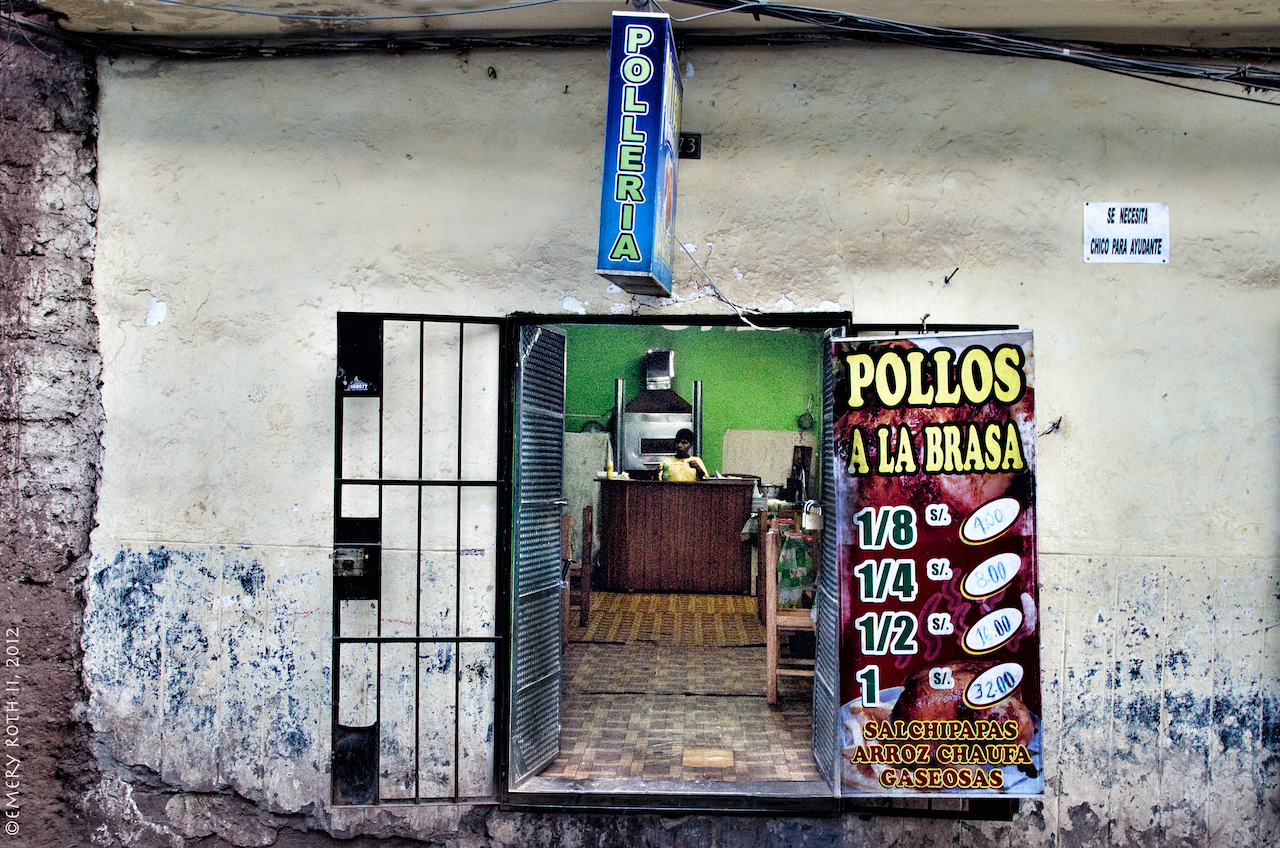
Polleria, Cuzco, 2012


PHOTOGRAPHER'S JOURNAL, "Cuzco, part 9": So, three days after the start of the siege of Cuzco, after the Spanish had built rude ladders and mounted a secret, bloody, night-time assault on Saqsayhuayman, catching the Inca army asleep and successfully battling to the top of the highest terraces, there finally dislodging Manco's fighters from the strategic fortress, the siege of Cuzco attained a stalemate.  Manco withdrew himself to Ollantaytambo where defenses were even stronger than at Saqsayhuayman, commanding his generals to continue the assault on Cuzco, and he sent his best general, Quizo Yupanqui, to watch the valleys between Lima and Cuzco to intercept and destropy any reinforcements that might try to get through. 

Quizo understood that the only way to win against the Spanish was to trap them from above.  Three times Francisco Pizarro sent battalions to help in Cuzco, and three times they were demolished by boulders hurled from steep cliffs in carefully planned traps, crushing men, horses, armor and all, until there were no battalions for Pizarro to send. All might have yet gone well for the Incas had Manco not ordered Quizo to wipe out the tiny new settlement of Lima in the flatlands. In the surviving accounts, Quizo charged hard riding in a litter carried by soldiers at the head of his army, and he was one of the first to die.

Sunday, August 26, 2012

Above Cuzco


PHOTOGRAPHER'S JOURNAL, "Cuzco, part 8": Cuzco sits at 11,000 feet in a highland plain surrounded by mountains. If one controls the mountains, one can control all access to the plain and the city.   Manco's siege caught the Spanish divided with Francisco Pizarro and half the forces far away in Lima establishing a new city. Pizarro's brothers were in charge in Cuzco with diminished forces. Saqsayhuayman was not only important because of its proximity to the city, but because prevented the Spaniards in Cuzco from slipping a messenger through to Lima to call for reinforcements.

The Incas might control Cuzco today if it hadn't been their custom when sunset came to stop fighting. The year was 1536. Machiavelli had been dead just nine years in Europe.

Thursday, August 23, 2012

Siege of Saqsayhuayman


Sancho de la Hoz (quoted from Last Days of the Incas by Kim MacQuarrie):  
"On the side of Saqsayhuayman that is less steep are three walls, one above the other. The most beautiful thing that can be seen among the buildings of that land are these walls, because they are of stones so large that no one who sees them would say that they have been placed there by human hands, for they are as large as chunks of mountains, and they have a height of thirty palms [twenty-one feet) and a length of as many more. These walls twist in such a way that if they are bombarded with cannons it is impossible to do so from directly in front, but only obliquely.  The whole fortress was a warehouse of weapons, clubs, lances, bows, axes, shields, vests thickly padded with cotton, and other weapons of various sort gathered from every corner of the realm that was subject to the Inca lords."


PHOTOGRAPHER'S JOURNAL, "Cuzco," part 7:  The siege of Cuzco was directed from Saqsayhuaman, high above the burning city. Its strategic location was critical for the noose that Manco was drawing around the Spanish forces. As Manco's armies closed in on the city, they pushed the Spanish toward the plaza beneath Saqsayhuaman. From above Manco launched punishing raids down the hillside which gave his forces the advantage of height.

So long as Manco remained in control of Saqsayhuayman, the foreigners were doomed.